


Explorer Essays are ambitious ideas written by startup founders operating in Canada’s critical industries. If you are a founder building frontier technology for Canada and would like to publish an essay or opinion in The Canadian Explorers, contact me at contact@ethanmarcoux.com.
Materials of Attrition
By Stuart Lodge, CEO and co-founder of Lodge Systems
Canada has 369 million hectares of forest, about 9% of all the forest on Earth. Our forests have built critical defence systems before. In the last war fought on wood, Canadian foresters cut 70% of the timber the Western Allies used.
Wood then left military use, for reasons that were sound at the time. But those are now outdated. The conflicts in Iran and Ukraine are rooted in cost and attrition. Canada has the world’s longest coastline and the second-largest landmass to defend. Its least examined advantage is the one covering it.
Advertisement — Marconi Technologies
The Canadian Explorers is proud to be supported by its Founding Lead Partner, Marconi Technologies.

Sea
In the 1700s, Royal Navy surveyors walked the forests of New England searching for the white pines. They marked the tallest with three hatchet strokes cut into the bark. This mark was the King’s Broad Arrow, meaning the tree now belonged to the British Navy.
A sailing warship needed a mast made from one tall, straight trunk, sometimes over 100 feet, able to carry full sail through a storm. Few trees grow that way. Eastern white pine does, and the best of it grew in North America. A single-stick American mast was stronger than one pieced together from smaller Baltic timber, and navies knew the difference. Britain lost the American colonies in 1783. Napoleon closed the Baltic in 1806. The fleet turned to the forests it had left in New Brunswick and Quebec.
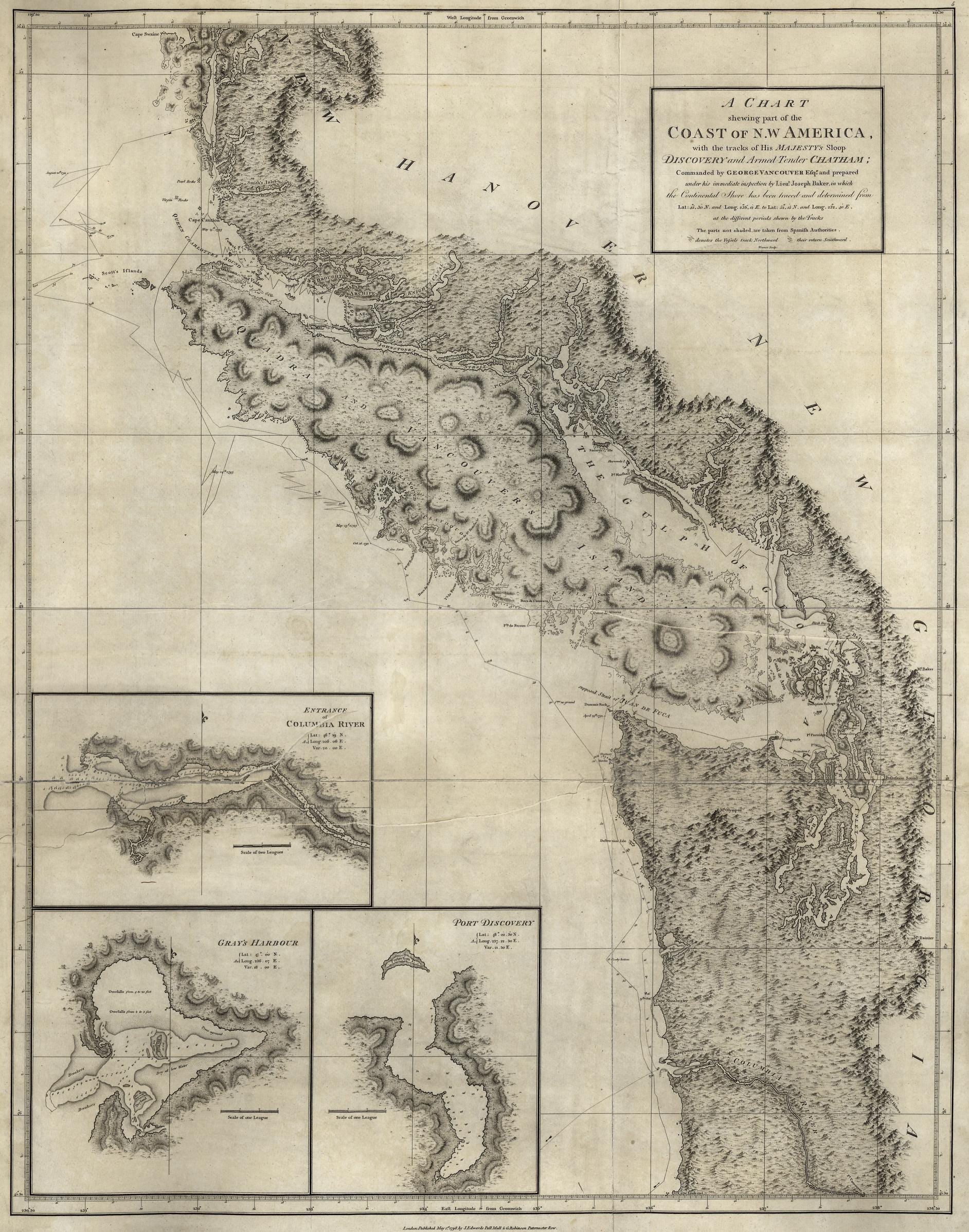
When Captain Cook reached Nootka Sound on Vancouver Island in 1778 with ships that needed repair, the forest of Canada’s West gave his men fir spars for a new mast. Word spread. Within years the coast was known among European powers for its timber, and George Vancouver, sailing the same waters in the 1790s, judged it among the finest wood anywhere. The tree that mattered here was the Douglas fir.
Wood was the most important military technology of the age. It decided how far and how fast a fleet could move, and Canada grew the best of it.
Forest
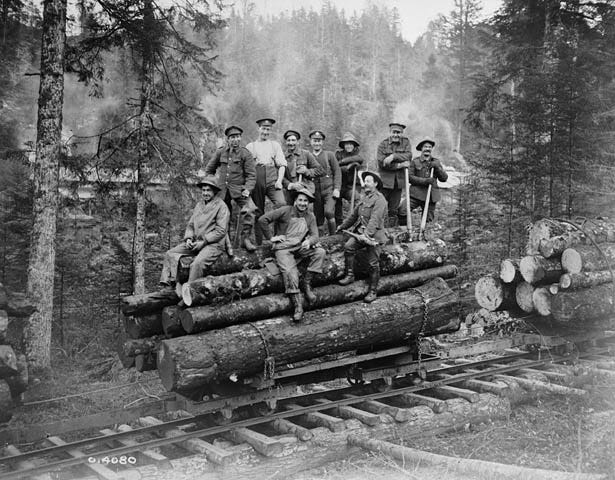
In November 1916, with Britain short of timber, Canada raised a military unit made of loggers. The Canadian Forestry Corps grew to about 35,000 men. By the Armistice, it had 60 companies working in France and 41 in Britain, cutting 70% of the timber the Western Allies used: trench props, railway ties, duckboards, aerodrome huts, everything that an army stands on.
Canada did not ship logs to Europe. It shipped loggers, saws and portable mills, and cut in the forests behind the front.
Air
De Havilland built a wooden plane in 1940, the Mosquito. It turned out to be among the fastest and most useful aircraft of the Second World War. For a period, nothing in the sky could catch it. It flew photo reconnaissance, night fighting and precision bombing.
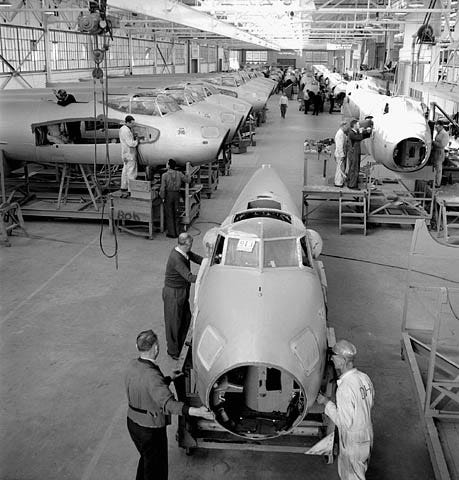
The airframe was spruce and birch, light and quick to shape. Building it from wood saved aluminum and freed metalworkers for other aircraft. The fuselage was formed in two halves over concrete moulds, birch plywood around a balsa core, with the wiring and control runs integrated before the halves were bonded together.
It also meant the work could be spread across industries that had never built an aircraft. In Canada, the fuselages came from General Motors, the Cockshutt Plow Company, the Otis-Fensom Elevator Company and the Canadian Power Boat Company. Massey-Harris built the wings and trucked them across Toronto to Downsview, where de Havilland ran a moving assembly line that reached nearly 60 aircraft a month by 1945. More than 1,000 were built in Canada, out of 7,781 worldwide.
Wood was not a leftover from a simpler time. With aluminum rationed, Hughes Aircraft built the H-4 Hercules out of birch. The flying boat had a 320-foot wingspan, the largest of any aircraft flown at the time. It was mocked as the Spruce Goose. The Soviet Union, also short of aluminum, built much of its fighter force from birch treated with resin. In each case, engineers chose wood because it was light, strong for its weight, and available in quantity when the alternative was not.
Why wood lost
Then wood went out of military use, and the reasons were real.
Riveted aluminum carried loads that glued wood could not. It held up in heat and damp that made wooden airframes fail. When jet engines arrived, and aircraft flew faster, the loads went well past what wood could take. Aluminum, and later carbon fibre, were the right materials for the aircraft that followed, and they still are.
That logic held for the wars we expected to fight. For 50 years, military strength has meant a small number of expensive, complicated machines, flown by crews and kept in service for decades. Steel, aluminum and carbon fibre are correct for those. Nothing that follows changes it, and that includes what we build. Wood is not for million-dollar systems, and it will not give you the complex surfaces of an aircraft like the F-35.
The war of cost
The fighting in Ukraine and Iran runs on something else. Much of it is small, cheap uncrewed aircraft, built and launched in very large numbers. In the first days of September, Kuwait and Bahrain activated their air defences against incoming Iranian drones, after Iran fired missiles at United States bases in Jordan.
A Shahed-136 is a one-way attack drone. It flies to a target and detonates, and it costs somewhere between US$20,000 and US$50,000; the Center for Strategic and International Studies uses US$35,000 as a deliberately high figure. The missiles fired to stop one cost between US$1 million and US$4 million each, with a Patriot at the top of that range.
The intercept is the cheaper half of the problem. The expensive half is what the ones that get through do when they land. Ukrainian military intelligence estimated that Russia spent US$325 million on its February 3, 2026 attack on Ukraine’s energy infrastructure, involving 71 missiles and 450 drones.
The wider damage from the war is mounting. The World Bank, the United Nations and the European Commission put Ukraine’s direct war damage at US$176 billion in February 2025 and over US$195 billion by the end of that year. Damaged and destroyed energy assets rose about 21% over the same twelve months. Rebuilding the energy sector alone is now estimated to cost nearly US$91 billion.
It runs the other way as well. In the first five months of 2026, Ukraine’s Unmanned Systems Forces reported striking 174 Russian air-defence assets, including missile systems, radars and electronic warfare equipment, with losses they value at more than US$5.4 billion.
You can win every intercept and still lose the war.
Volume follows from price. Ukraine’s commander-in-chief says Russia is producing around 400 Shahed-type drones a day and plans to reach 1,000. Ukraine built 3,000 to 5,000 FPV drones in 2022 and about 3 million in 2025, with current capacity put at 8–10 million a year. It is a manufacturing contest, and it is being won on cost per unit.
Both sides returned to simple materials to get there. Some of Ukraine’s long-range attack drones are now milled from plywood sheets of the kind furniture factories already stock, built without skilled labour, and treated as expendable.
That is not crude, but it is limited, and it is a limit we run into ourselves. A flat sheet will not give you an aerodynamic surface, and it will not reduce assembly times. Moulding does both.
The advanced materials perform much worse on cost per unit. Steel is heavy. Carbon fibre is expensive, slow to lay up, and more than half the world’s production capacity now sits in China; the largest single producer, Jilin Chemical Fibre, has approximately 74,000 tonnes of annual production capacity.
What changed about wood
While wood was out of service, there were two major shifts: the wood and the machines that manufacture it.
Wood is no longer just a plank. Engineered timber is layered and bonded under pressure, and the newest wood fibre products hold their shape in heat and moisture, which was the exact failure that ended wood’s military career. Timber of this kind carries roughly twice the load of steel for the same weight.
The machines had a bigger impact. The only way to work wood used to be by hand, which meant every piece came out a little different and nothing was truly consistent. It is now cut on the same computer-controlled equipment used for metal, to the same tolerances, from a digital model that predicts how the finished part will carry load before anything is made. The skill sits in the file rather than in the hands of the person at the bench. That is where most of our work goes, and it is why a part can be copied, sent to another shop, and run the same way again.
Aerospace carbon fibre runs tens of times the price of aircraft-grade wood by weight. A worker laying it up by hand places about 1 kg of material per hour; the automated machines that replace them run at 300 kg/h, and cost more than most manufacturers are willing to spend. Wood cuts quickly on machines that already sit in shops across the country.
Wood also affects radar visibility. Radar works mostly on size and shape. A large flat surface angled at the transmitter returns a strong signal; a small one does not. What the object is made of decides how much of that signal survives. Metal conducts, so it reflects almost everything that reaches it. Carbon fibre conducts too, which is why it shows up better than plastic or foam. Wood does not conduct, so a wooden airframe can return less than the same shape built from metal or carbon fibre. None of this hides an aircraft. Shape and size still decide most of the return. But unlike metal or carbon fibre, wood doesn't add to it.
What Canada does with its own
Canada tends to export the raw materials and buy back the value. It is the largest single supplier of crude oil to the United States, and in 2025 it still imported more refined petroleum products than it sold. Wood runs the same way. British Columbia shipped 2.75 million cubic metres of unprocessed logs in 2024, and in February of this year the province made shipping them cheaper still, cutting the fee it charges exporters for skipping domestic processing.
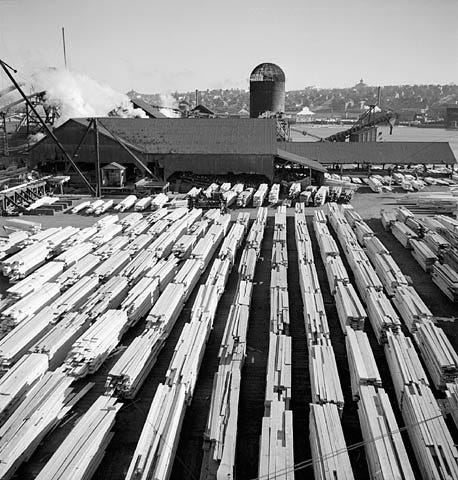
The mills, meanwhile, keep closing. Forty-four sawmills in British Columbia have shut permanently since 2005. Since 2023, at least 21 B.C. lumber mills have closed permanently or indefinitely. Statistics Canada counts more than 40,000 forest-sector jobs lost in the province since the early 1990s. The industry supported over 200,000 direct and indirect jobs in 2001 and supports about half that today. In 2025, British Columbia lost the Crofton pulp mill, the West Fraser sawmill at 100 Mile House and the Drax pellet mill at Williams Lake.
Some of that is already fixable. Our material is grown in renewable British Columbia forests and bought from businesses owned and operated here. What we make from it cannot be bought off a shelf or produced on standard machinery, which is exactly the kind of work the country is currently exporting.
The buyer
Reversing that needs someone at home buying the finished part. On 23 July 2026, the federal government launched the Defence Drone Initiative, a procurement route for Canadian uncrewed systems led jointly by National Defence and the Defence Investment Agency. Uncrewed systems are one of 10 sovereign capabilities named in the Defence Industrial Strategy. Of the six priorities in the first phase, two are low-cost tactical ISR drones and low-cost counter-drone interceptors. Behind it sits Canada’s NATO commitment to spend 5% of GDP by 2035: 3.5% on core defence and a further 1.5% on defence-related infrastructure and security.
Low cost, at volume, from a supply chain Canada controls. Lodge Systems is working on that in Vancouver. We are building the processes, physical and digital, to bring the current generation of wood fibre products into uncrewed aircraft: how the material is formed, how parts are designed and modelled, and how they are produced repeatably at rate. The aircraft are already flying, in test with commercial and government partners.
None of this replaces steel, aluminum or carbon fibre. Those do jobs wood cannot, and the exquisite systems will go on being built from them. Wood is for the other category: the things needed in large numbers, at low cost, and expendable. That category is now more important than ever.
Twice, the wood to fight a war came out of Canadian forests. Those forests are still standing.
About the Author
Stuart Lodge co-founded Lodge Systems, a Vancouver manufacturing-technology company building sovereign structural components for uncrewed systems from Canadian materials. He came from timber and robotic fabrication, and lives in British Columbia.

Lodge Systems is a Canadian manufacturing-technology company based in Vancouver, British Columbia. It builds sovereign structural components for uncrewed aircraft, made to be light, strong, and produced at scale from sovereign materials.

Partners of The Canadian Explorers

The Canadian Explorers works with a limited group of sponsors that support the founders and startups solving Canada’s most difficult problems across defence, deep-tech and other critical industries.


Sources
Canada’s forest endowment:
How much forest does Canada have? Natural Resources Canada.
A look at Canada’s lumber industry in 2024, Statistics Canada.
Masts, the Broad Arrow, and eastern timber.
Broad Arrow Policy, Wikipedia.
The King’s Broad Arrow and Eastern White Pine, NELMA.
The Royal Navy’s War on Trees, Legion Magazine.
Cook, Nootka Sound, and West Coast spars.
The Evolution of West Coast Logging, Legion Magazine.
Cook, Captain James, BC Genesis, University of Victoria.
Nootka Sound, The Canadian Encyclopedia.
The Canadian Forestry Corps.
Canadian Forestry Corps, Wikipedia.
FPAC Remembers the Canadian Forestry Corps, Forest Products Association of Canada.
The Mosquito, the Hercules, and Soviet wooden fighters.
de Havilland Mosquito, Wikipedia.
Mosquito Aircraft Production at Downsview, Community Stories.
Hughes H-4 Hercules, Wikipedia.
Lavochkin-Gorbunov-Gudkov LaGG-3, Wikipedia.
Drone cost and the intercept exchange.
Iran targets U.S. allies in Gulf after overnight attacks, Associated Press.
Calculating the Cost-Effectiveness of Russia’s Drone Strikes, CSIS.
The Shahed Model: Cost Asymmetry and the Transformation of Air Warfare, BISI.
Damage caused, and the cost of a single wave.
Ukraine: $588 billion recovery cost over the next 10 years, UN News.
Production volume.
How Ukraine Became a Drone Superpower, Just Security.
Russia plans to use up to 1,000 attack drones against Ukraine every day, Ukrainska Pravda.
Ukraine’s Scythe Drone Is All About Striking Far Away As Cheaply As Possible, The War Zone.
Carbon fibre supply and cost.
An outlook on China’s carbon fiber market, CompositesWorld.
Jilin Chemical Fiber Group Leads Global Carbon Fiber Production.
Carbon Fibre in an Automated Manufacturing World, Machine Design.
Engineered timber and radar.
Laminated Veneer Lumber, StructureCraft.
Low signature UAVs: radar cross section analysis, simulation and characterisation, Springer.
Raw-log exports, mill closures and forestry employment.
BC Quietly Cuts Penalty for Exporting Unprocessed Logs, The Tyee.
Mill closures pile up as BC harvest lags behind allowable cut, Business in Vancouver.
B.C. forestry industry is dealing with death by a thousand cuts, Business in Vancouver.
Crude oil exports and refined product imports.
Market Snapshot: Overview of 2025 Canada-US energy trade, Canada Energy Regulator.
Canada’s refined petroleum product imports rose in 2025, Canada Energy Regulator.
The Defence Drone Initiative and the NATO commitment.
Government of Canada launches Defence Drone Initiative, National Defence.
Defence investment and NATO’s 5% commitment, NATO.
Fiscal Implications of Meeting NATO’s 5% Commitment, Parliamentary Budget Officer.