


“an overdue and meaningful shift that rightly prioritizes build–partner–buy, faster procurement at the speed of the threat, and the deliberate cultivation of Canadian defence champions.” — Eliot Pence
Current Situation
Canada is launching its most extensive defence investment plan since the Korean War. Pledging ~$82 billion over five years to the Canadian Armed Forces, and committing to a 5% GDP defence target by 2035 (from what was 1.37%).
However, decades of underinvestment have left Canadian defence systems outdated and underequipped. Canada has no major homegrown defence primes and has historically relied on U.S. imports, making up 3/4 of Canadian defence spending. The Defence Industrial Strategy seeks to change this.
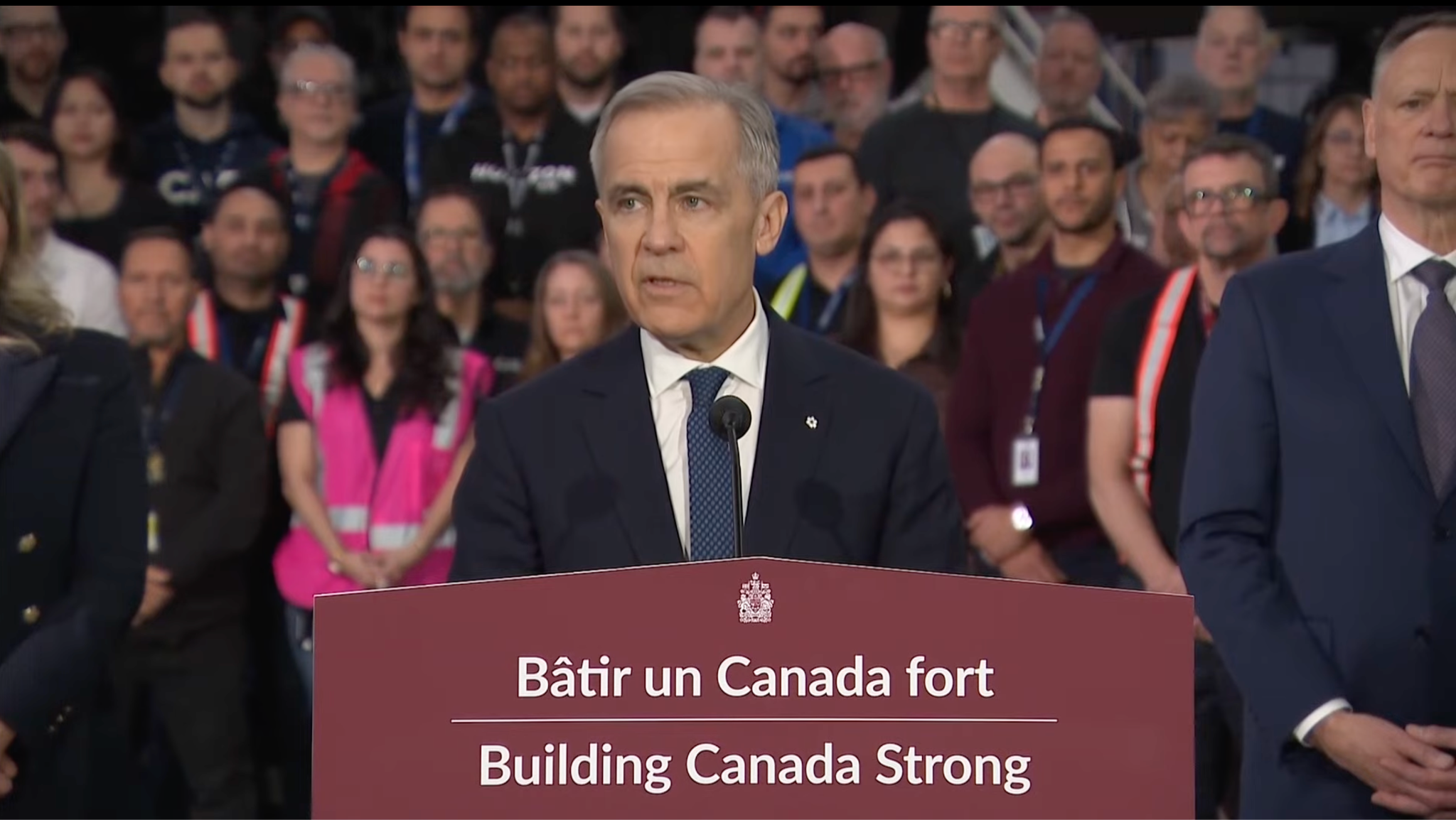
“Over the last few decades, Canada has neither spent enough on defence nor invested enough in our defence industries and we have relied too heavily on our geography and other countries to protect us. This has created vulnerabilities we can no longer afford and dependencies we can no longer sustain.” — Mark Carney, DIS launch speech, Feb. 17, 2026
Canada has become the frontrunner to host the Defence Security and Resilience Bank, and recently became the first non-EU country admitted to the EU’s €150B SAFE defence procurement program. Meanwhile, it is actively investing in the startup ecosystem with the BDC’s $4b platform to boost Canada’s defence and security ecosystem.
Currently, the Canadian Defence sector contains ~600 firms, $14.3b revenue, and 81,000 jobs.
There has been a “seismic shift” as banks, pension funds and other major investors remove or reconsider exclusionary clauses that previously restricted putting capital into defence businesses, said Benjamin Bergen, chief executive officer of the Canadian Venture Capital and Private Equity Association. He expects “a tremendous amount of capital” to be unleashed. — Bloomberg
Can Investment in Defence Kickstart a New Era of Canadian Innovation? [Industry Spotlight]
![Can Investment in Defence Kickstart a New Era of Canadian Innovation? [Industry Spotlight]](https://substackcdn.com/image/fetch/$s_!vhj9!,w_280,h_280,c_fill,f_webp,q_auto:good,fl_progressive:steep,g_auto/https%3A%2F%2Fsubstack-post-media.s3.amazonaws.com%2Fpublic%2Fimages%2F3d9ceef1-f24a-4481-9dba-46cfdfe0548d_1440x1080.png)
TL;DR Canada is entering a historic defence budget at a time when its venture ecosystem is struggling. Procurement and financial barriers that have long held defence companies back are beginning to ease, and history suggests that defence-led R&D doesn’t stay contained. This piece analyzes whether Canada’s renewed defence investment could become a meaning…
What is the DIS?
The Defence Industrial Strategy is both an economic development and a defence strategy. It outlines a plan to create 125,000 new jobs (to ~206,000), and increase defence industry revenues by over 240% (to ~$48.6b) by onshoring the defence industrial base, and diversifying from foreign reliance.
The Canadian Procurement Moat
As 3/4 of Canadian defence capital goes to the US, the Canadian government is reforming the defence procurement system. Protecting and incentivizing Canadian firms and IP ownership under the new BUILD-PARTNER-BUY Framework
Build — Canadian companies first, as a matter of policy.
Partner — Like-minded allies second. Focusing initially on Europe, the UK, Indo-Pacific and beyond, attracting investment, transferring IP, and integrating supply chains to create Canadian jobs.
Buy — Foreign last resort, with conditions that spur reinvestment and ensure sovereignty over operation and sustainment, such as the Industrial Technological Benefits (ITB) regime.
“If and as needed, procurement authorities and legal frameworks will be adjusted to enable this approach, including use of the national security exception to direct work to Canadian firms.” — Canada’s Defence Industrial Strategy, Feb. 17, 2026
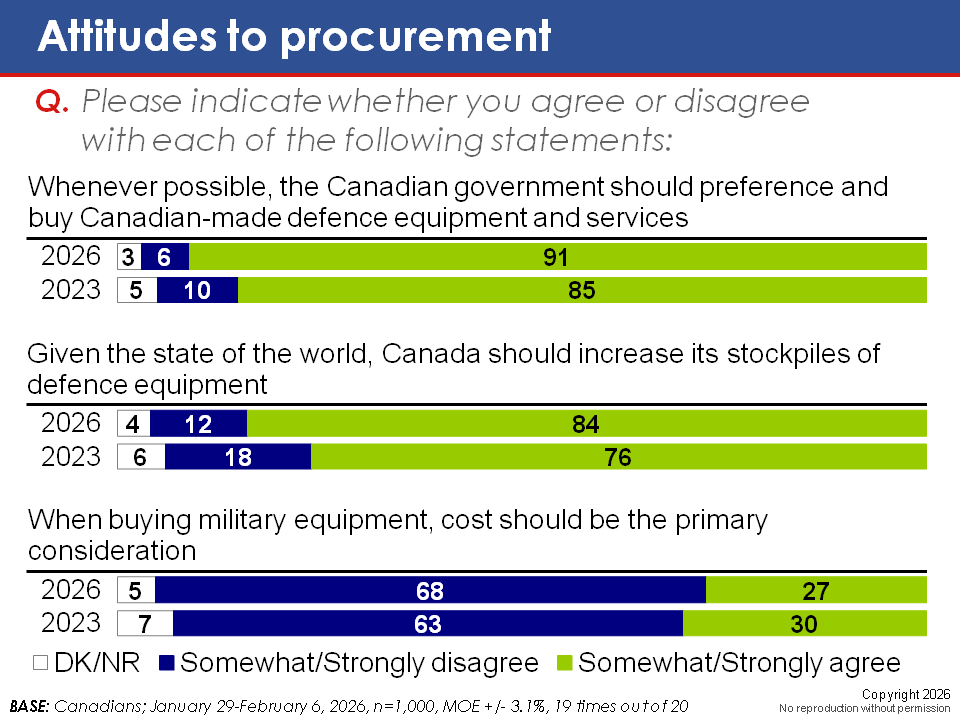
The National Security Exception is a legal mechanism that lets the government bypass competitive bidding and trade obligations, meaning Ottawa can sole-source contracts directly to Canadian firms without opening them to foreign primes. Using these mechanisms, Canada is seeking to move the proportion of domestic procurement to 70%, an advantage for Canadian defence firms over foreign competitors.
Along with increasing total defence investments, this creates a massive financial gap and opportunity for Canadian firms to fill. Though the DIS hedges, committing that procurements will “typically” be directed to Canadian firms
When Canada needs to buy, foreign primes are required to reinvest back into Canadian industry through Industrial and Technological Benefits (ITB). The DIS reforms are now providing incentives to invest in Canadian-owned startups specifically, making SMBs the most efficient way to meet ITB obligations. This boost will provide an additional influx of capital towards building new homegrown Canadian defence tech companies. Full terms and conditions for the Industrial and Technological Benefits will arrive early this year

Canada is also seeking to build up its National Defence Champions program, which will select Canadian defence firms as key strategic partners. In which firms will receive direct procurement, R&D funding, access to research and testing infrastructure, and additional support
However, the DIS does not define what constitutes a 'Canadian company.' According to the Canadian Shield Institute, only 57 of the top 100 Canadian defence companies are Canadian-Controlled. Without a clear definition, the 70% domestic procurement target risks directing billions to foreign-owned subsidiaries operating on Canadian soil.
Procurement & Exports
The key bottleneck for the Canadian defence industry has been procurement, which has made rapid innovation nearly impossible, taking up to 16 years. Thus, Canada is making the DIA (Defence Investment Agency) a centrepiece of the DIS. Centralizing Canada’s defence procurement, cutting red tape, expanding production, and increasing the speed of deployment. Meanwhile, Canada is working to establish a Defence Advisory Forum and is accelerating security clearance processes for defence-sector personnel.
When the DIA launched last October, its initial focus was on contracts above $100m and providing advisory capacity below. However, the $100m figure is not in the DIS, stating that the DIA will apply the “Build—Partner—Buy” framework to all future defence acquisitions. This is an advancement towards more efficient procurement systems for SMEs and startups. If Canada seeks to build a sovereign defence industry and facilitate start-up growth, this <$100m gap is critical. Standalone legislation is coming to the Defence Investment Agency this Spring, where this should be clarified.
However, meaningful improvements to procurement remain questionable. The Defence Industrial Strategy admits it will remain a difficult process, “even with more efficient defence procurement, Canadian companies will still need to engage with multiple agencies.”

Furthermore, Canada is seeking to increase defence exports by 50% in the next ten years. Carney has explicitly stated that this is a two-way trade, as Canada will be focusing on broadening its partnerships with countries such as South Korea.
Canada’s domestic military investments align with the global trend toward increased defence spending, startups, and venture investments.
European defence spending is projected to grow 3.4x over the next six years, making defence Europe’s fastest-growing sector. — Bessemer Venture Partners
Trump calls for record $1.5 trillion defence budget, a 50 percent jump. — Politico
PitchBook data shows nearly 8% of all VC funding globally now goes into defence tech ventures as of late 2025. — GoingVC
Opportunity
National security now runs on startup innovation.
Canada is investing over half a trillion dollars in defence, and domestic procurement is shifting to 70% of purchases backed by a national security exemption. This creates a moat against foreign competitors. Meanwhile, there are no major pre-existing defence prime contractors, infrastructure is outdated, and the military is under-equipped.
Significant risks remain. The "Canadian company" is undefined, enforceable mechanisms are lacking, and procurement barriers persist. But the window is open. The Canadian companies being built today are not entering an industry. They're creating one.
Canadian Defence Startups to Watch
Dominion Dynamics: $26M raised (Georgian, Bessemer, BCI), building Canada's first defence "neoprime" with AI-powered sensor networks and command-and-control systems for Arctic and contested environments.
Juno Industries: $3M seed, former Defence Minister Harjit Sajjan as executive chairman, Geordie Rose (D-Wave, Sanctuary AI) as senior advisor. Building dual-use autonomous systems for sovereignty and national security.
North Vector Dynamics: Backed by Kensington and One9, with $4.2M in DND contracts and $2.5M in IDEaS grants. Building counter-drone and hypersonic defence systems.