


Prandtl Dynamics began in 2023 as a student team building counter-drone technology. It has since placed second at two Department of National Defence Counter-UAS Sandboxes, earning $750,000 in total DND prize money. The company is now deploying its systems at universities and airports and expects to soon reach 600 units across over 150 to 200 deployments.

Many methods of drone defence are either too destructive, too expensive, or too difficult to use in urban environments. Prandtl’s technology is designed to make counter-UAS safe, low-cost, and non-lethal. The core system, Dome, emits pulses of inaudible ultrasound that cause a drone’s electronic and mechanical components to vibrate and produce detectable sound, revealing a hidden drone before it is ever powered on.
I asked Parth Mahendru, CEO and co-founder of Prandtl Dynamics, a few questions about acoustic counter-UAS technology, manufacturability, and what it takes to build a national-interest company in Canada.
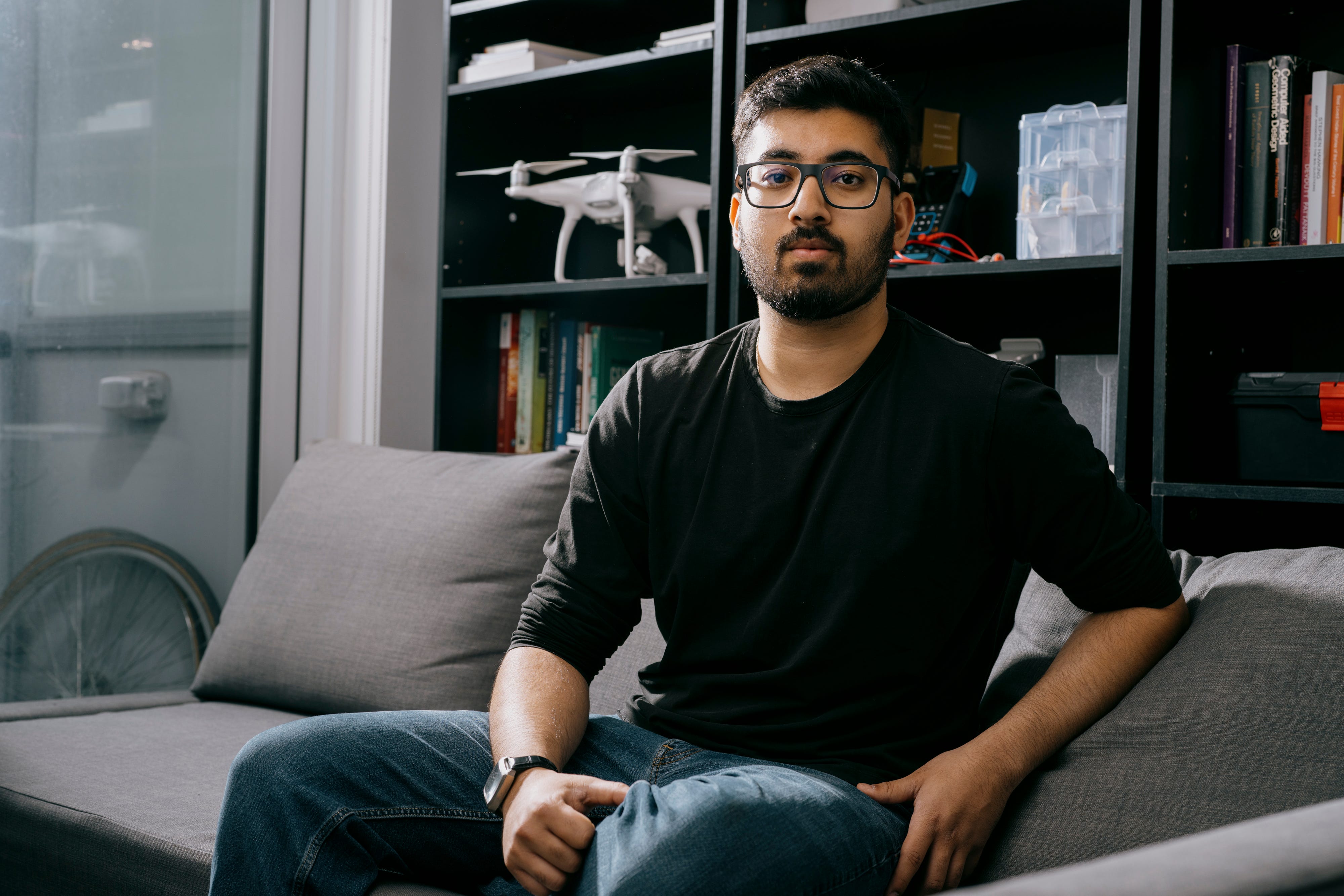
In one sentence, what is Prandtl building, and why?
“We are building a non-lethal acoustic sensing and counter-drone system that is low-cost enough to be deployed in real-world conditions, including critical infrastructure, utilities, and first responders. Airspace and critical infrastructure have typically been left exposed, and nobody is building the right tools to protect them.”
Why acoustics? What can sound do that other counter-UAS systems cannot?
“We started as a student team. We wanted to do something interesting, and we thought that drones were a big threat. Why not make something to protect against those threats? Because anyone can fly a drone.
The reason why we chose acoustics is out of necessity. Back then, we were looking at solutions, and there were nets. We did not have access to nets, nor a net-throwing mechanism. There were lasers. We had no access to lasers either. We didn’t have missiles. We didn’t have microwave tech. We did disassemble a microwave, on the other hand, though, as a fun project to use it as a directed energy source. All of these are stupidly expensive. They’re pretty much impossible to do unless you have the infrastructure built.
Then we looked at sound. Sound is more ubiquitous. It’s easier to produce. It’s easier to obtain. It’s easier to use. And it’s also safe. So the reason why we chose sound is the fact that it can work in any condition.
Sound is non-lethal. Even our tech that defeats these drones is non-lethal. And that’s core to what we build. It is safe technology that we mean for everyone to use to protect them against these threats. Our tech only works on machines; it doesn’t really work on humans. We don’t really care what we’re protecting, but we’re protecting it in a safe way. Even if there’s a human person or a living organism in the middle, they’re not going to be affected.
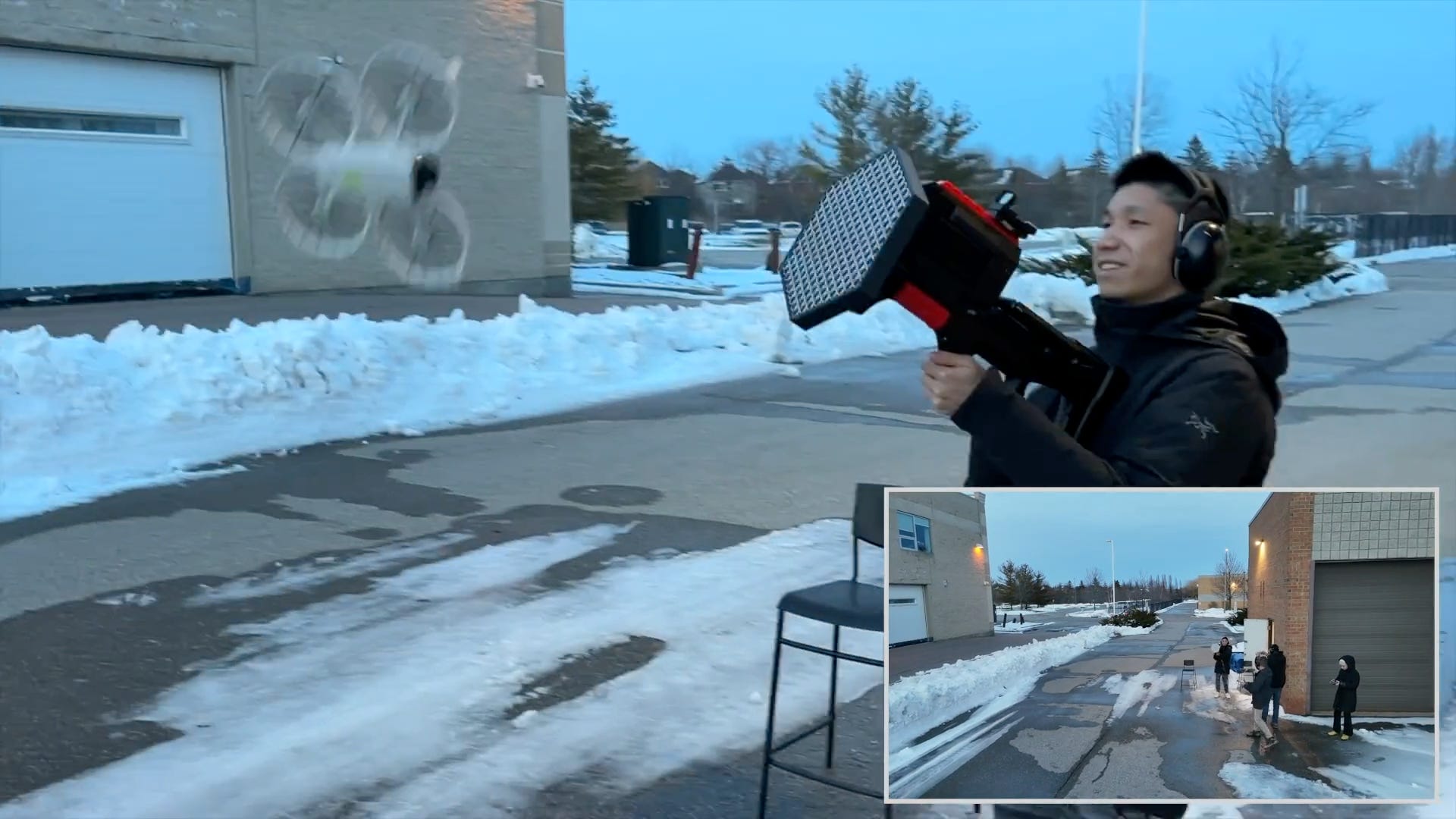
How did you discover sound could do this, and how does the product work?
“One of the co-founders, Anna, is a materials scientist, and in her work, she uncovered that there’s a big formula between sound, electric field, and magnetic field. There’s a tensor that exists. Basically, that means there’s a relationship.
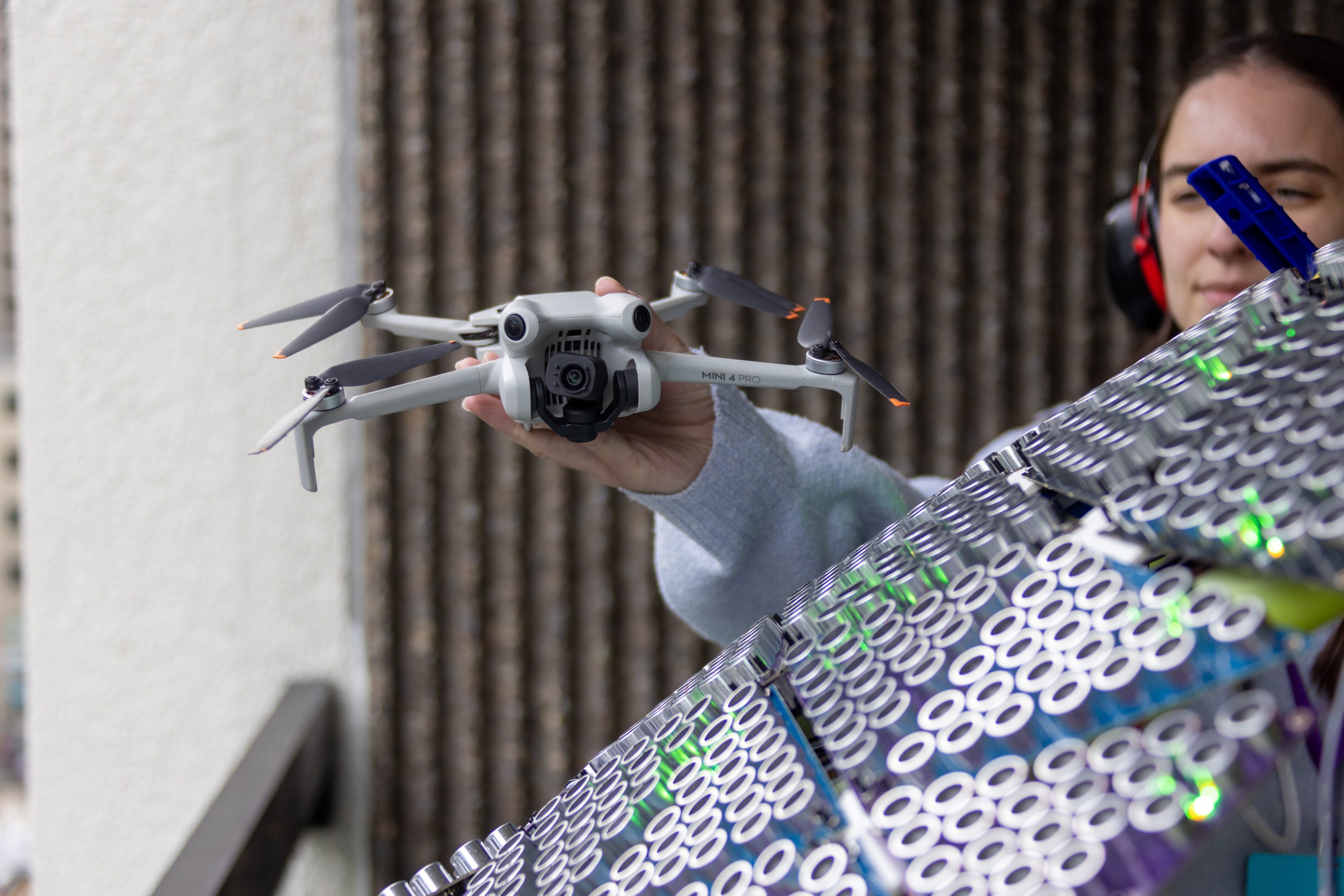
Because drones have electronics on them, they have all these PCBs, the boards, they have electrical signals, and all these sorts of data processing units, like speed motor controllers, IMU, stability control. What we do is we selectively target a cluster of electronics, and we blast them with high-powered sound, and it’s not just high-powered sound. We blast this sound in a very particular and controlled manner so that we’re able to excite internal electronics to fail in a particular way.
Meaning we shoot high-powered sound at a drone, which is a dynamically changing sound beam that we produce. And it’s able to push the drone back or make it fall to the ground. I would also admit that the use case for this is niche. It’s a significantly lesser range than, say, a machine gun, a microwave or a laser system. But that’s not the intention of our tech. It’s not the intention to replace the system. Our tech is a supplementary add-on, which is a non-lethal piece of machinery that you can hand off to anyone to defeat drones.
An interesting thing we do is selectively spoof the drone’s cameras. Meaning the drone stays where it is, but the camera is spoofed, which helps with ISR (intelligence, surveillance, and reconnaissance) purposes, like surveillance.”
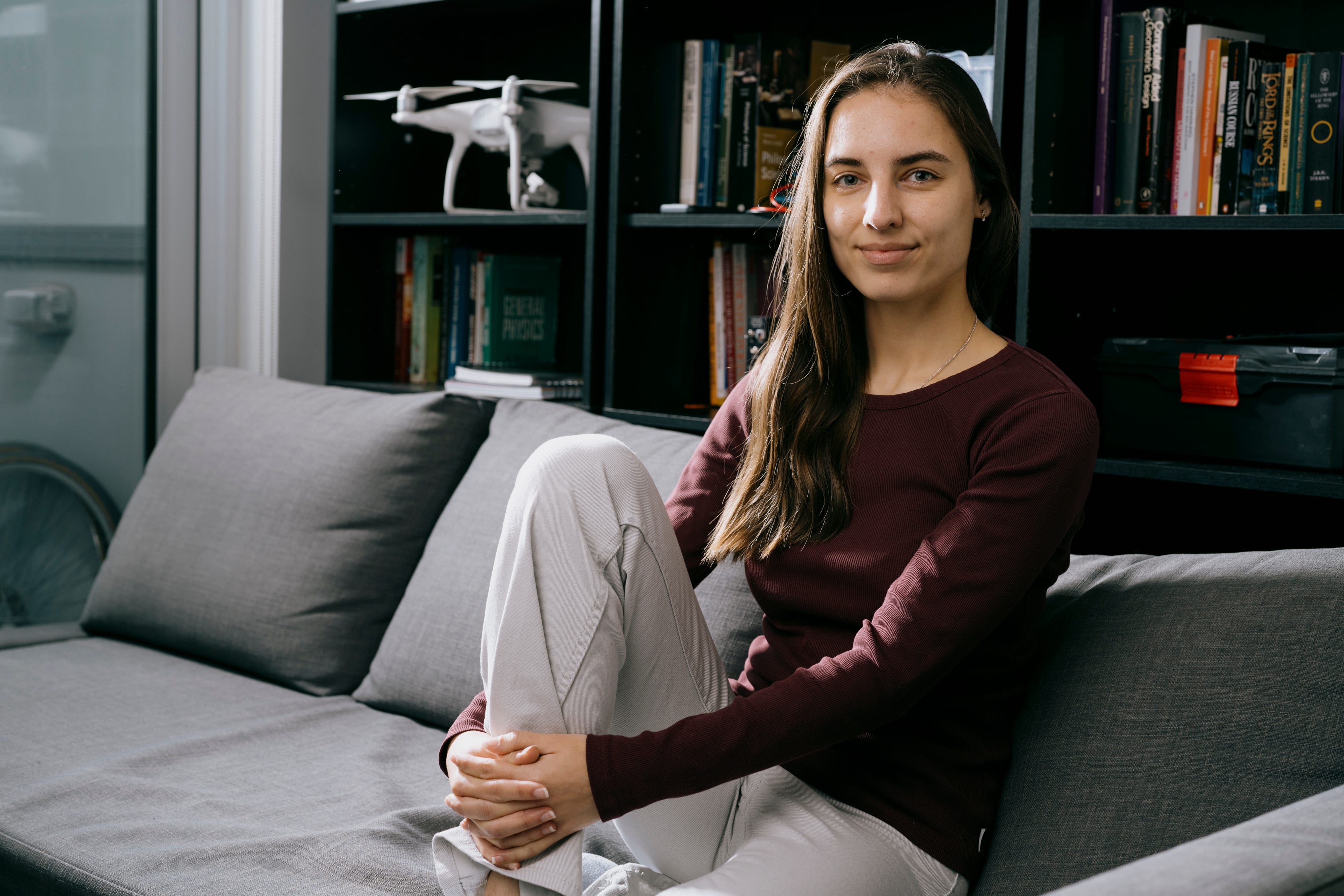
What is one thing people misunderstand about counter-UAS?
“The typical thing people misunderstand is that one solution kills all. Counter-UAS is a very sophisticated problem with a lot of ifs and buts about it. One solution can realistically never fit all scenarios. You need different systems and systems of systems.
When people are complaining about a system from, say, RWS, remote weapon systems guys, the people who have the machine guns on the turrets, and they claim, “Oh, you can never use this in urban environments or in a city,” they’re correct on paper. But the use case is much more defined. It’s more detailed, and it’s not as easy as it sounds. Maybe you would want an RWS, a remote weapon system, somewhere around your perimeter, which is in a rural area, for example, and you’d want something non-lethal, like acoustic systems, in a city.
You can’t realistically use our acoustic system over kilometres. The range just doesn’t work that way. But an RWS does that. That doesn’t necessarily mean that one is better than the other. What’s going to be even better is all of them working together as a system of systems.”
30 Startups for a Sovereign Canada | Canadian30

Canada is recognizing the need for national sovereignty through hundreds of billions of dollars in generational investments, such as the Defence Industrial Strategy, the Canada Strong Fund, and its new National Artificial Intelligence Strategy. According to The Canadian Shield Institute, Canada's defence spending is projected to increase
What’s the biggest problem preventing early-stage companies like yours from scaling?
“Honestly, I’ve seen a lot of companies succeed. What they have, and where we’re trying to do better, is manufacturability.
This is something that I feel is missing. Companies typically outsource manufacturing and are left only doing high-level design. So when it actually comes to producing at scale, the typical answer is, “Oh, get it made from somewhere else.” But if you’re working in a sensitive field where people are trusting you with their data, you need to ensure that whatever you produce is top quality and it’s something you can stand behind.
In that sense, building your own tech, which is something that we’re starting to do more of, we’re producing more units every month for all of our product lines. That’s why I think it’s problematic for smaller companies: understanding the difference between prototyping and manufacturability. That is a very key thing that took us a while to get.”
Balancing in-house manufacturing with partnerships.
“Definitely leveraging the capabilities of your allies is huge. There’s no need to reinvent the wheel if it already exists. Manufacturability, as I said, is supremely important. But it’s not necessary to make everything yourself. It is necessary to understand your logistics, to understand where your components are coming from.
What happens when one mine in China that makes neodymium closes down for a week? What happens to you? Understanding supply chain risks, logistics, and making sure that you can build stuff yourself, especially for sensitive applications like aerospace, defence, and drones. Definitely takes getting used to if you’re coming from software, SaaS or commercial hardware.
We’re also getting all our PCBs and all our electronics made in-house. We have people in our facility genuinely just screwing things together, making it. That speaks to something. And yes, that does command a more premium price than getting everything made in China. But I think we’d rather have that for a sensitive application: build everything in-house, made in Canada, made in North America, however you want to phrase it. That is not just important for sovereign building capability, but also for your own supply chain and logistics from a practical point of view.”
What’s one trait you think a founder needs to succeed in this market?
“What I genuinely believe is that for anyone to succeed in anything, you just have to be annoying with what you want and be persistent about getting it. I think persistence and perseverance. Those are two qualities that I live by. Just persistence and perseverance.”
What do the next 12 months look like for Prandtl?
“Right now, we’re deploying our tech in universities and airports to protect against these drones. Most of this tech is for detection purposes. We’re not yet selling our defeat capability. Those are being demoed to friendly allied countries and nations, and we’re selling or leasing out a few units to them for defeating drones, but not everyone wants to shoot down drones. Sometimes you just want to know if there is a drone in your airspace, and you can contact the authorities. We are making systems that are ultra-low-cost, made in Canada, that you can use to create a mesh network of sensors and protection around your facility. We’re eventually heading to more critical infrastructure, like power grids, nuclear plants, and data centers.
We hope to soon be around 600 units deployed in total, with over 150 to 200 different deployments. We’re going to continue going from there, protecting against drones using sound as one modality. We’re also making tech that I can’t talk about for the DND, for the DOD, for other allied defence countries, which corresponds to dismounted protection, meaning protecting a person against drones, like a soldier against drones.
We’re making all sorts of form factors in that tech, but that’s the law enforcement government side of things. We’re also expanding into the commercial sector over the next 12 months. I think we’ll have a decent foothold in the commercial sector for protecting against drones with sound, because it’s a very private, very simple modality. You’re not peeping into other people’s windows. So regulations are also more relaxed, and people genuinely need a system to protect against drones. As you see from FIFA, I guess two people got arrested, one for flying their drones over a stadium. We’re going to continue seeing things like this. The need to protect your critical infrastructure, or your house, or even a school, from these unauthorized drones that could be carrying out just about anything will become of paramount importance.”
What feedback are you hearing from customers?
“We have one customer specifically in Northern BC and Alaska. We’ve deployed our sensors over, I think, a 30-kilometre perimeter, our mesh network sensors, and we’re protecting against small and large drones.
We’re detecting all sorts of things over there because our tech is modular, meaning we can detect drones, planes, animals, and illegal mining equipment. And that is very important for this end user.
We’re getting feedback. They just want more things. They want more features. They want more detection capabilities. They want to detect birds. Some of them want to detect fires. Some of them wanted a phone app. So we also built an iPhone app for this purpose, to check on your deployments. Some of them also wanted features to record just the noise level, which is mostly in airports. They want to know how loud it gets so that they have an audit trail to protect against any sort of claims afterwards, to say that we were consistently below this sound level. The general feedback has been overwhelmingly positive. That’s why we’re expanding so much into the commercial sector, and not just the military sector.”
What’s the range?
“It depends on the size of the drone and on which sensor you have. Our cheapest sensor is called Bennu. It can detect drones. Typically, a hundred meters out in radius, 360 degrees. That is, I’m talking about a very small drone, like a less than 250 gram drone that you don’t need a license to fly.
A bigger FPV drone can be detected at over double the range of the sub-250g drone. And you can push that even more for larger airplanes and fixed wings. For example, a Cessna we can detect from a multi-kilometre range before it comes into sight and after it’s gone out of sight. Something like a Boeing 767, 747, we have that at a few multi-kilometre ranges as well. Not that you need to detect big airplanes, but surprisingly, drones like the Shaheds and these larger fixed-wing aircraft sound very similar to Cessnas because they’re approximately the same size.”
What other Canadian national-interest startups are worth watching?
“I’m going to say OBJEXIS AI. Those guys are very cool. They’re doing some very cool things. They’re veteran-led, which means a lot. The CEO is a good friend of mine. His tech was genuinely impressive. He came second with us in Sandbox 2025. I think that is one we need to look out for.
That is one company to look at. We might be working together with them. We’ll see.”
Why build in Canada?
“I think Canada is very conducive to growth and to new companies. It doesn’t shush you away when you need support. And it is a healthy place to build. It is not a cesspool of 500 different startups doing the same thing and just killing your idea.
People are genuinely helpful. It’s about the Canadian spirit, and it shows in not just the way we do things, but how we operate and how we treat others. That means a lot to me, being grounded in morals and ethics, that’s reflected in how we do business.
I can personally appreciate that because that’s also how we build. We’re working with universities and high schools. We’re doing some upskilling programs. We’re getting high schoolers. We’re teaching them how to solder. We’re teaching them how to build components, understand PCB layouts, and all of these things, which is something that we felt university didn’t teach us, or high school didn’t teach us.

This is one of the schools, and they were so happy that we taught a few of their students how to solder, 3D CAD modelling, and engineering design. They gave us this certificate of appreciation. It’s the culture of giving back, which is why we’re building in Canada.”
If you’re building something in Canada, I want to hear about it. contact@ethanmarcoux.com
Canada's First National Security VC | Glenn Cowan — Explorer Spotlight #3

ONE9 is Canada’s first national security venture capital firm. It was founded in 2013 by Glenn Cowan, a former JTF 2 (Joint Task Force 2) Squadron Commander in Canada’s special forces. In 2025, ONE9’s venture capital business was acquired by Kensington Capital Partners


Nobody likes a hater, but this is going nowhere. The acoustic vulnerability they hint at only applies to a small subset of the most crappy, vulnerable UAVs - the hardware equivalent of targeting an old, obsolete version of Windows with a known security flaw. Moreover, even with an ideal target, it doesn't work at any practical distance. Case in point: the "prototype" in their photo is already quite large and is "disabling" a toy drone from less than a half meter away. You can hear them managing expectations already because they know this doesn't scale. The idea you could "push back" a drone with this, in anything but the most contrived scenario and meaningless way, is ridiculous.
Technically illiterate optimists might want to wave these problems away, but the problem here isn't "you can't make the solution cheap enough, or small enough" - it's "the physics of acoustic propagation mean this approach is doomed".
Also, can someone explain what the following excerpt means?
> "An interesting thing we do is selectively spoof the drone’s cameras. Meaning the drone stays where it is, but the camera is spoofed, which helps with ISR (intelligence, surveillance, and reconnaissance) purposes, like surveillance."
What is meant by spoof, and how does spoofing (or disrupting?) video help with surveillance? Oddly written article.