


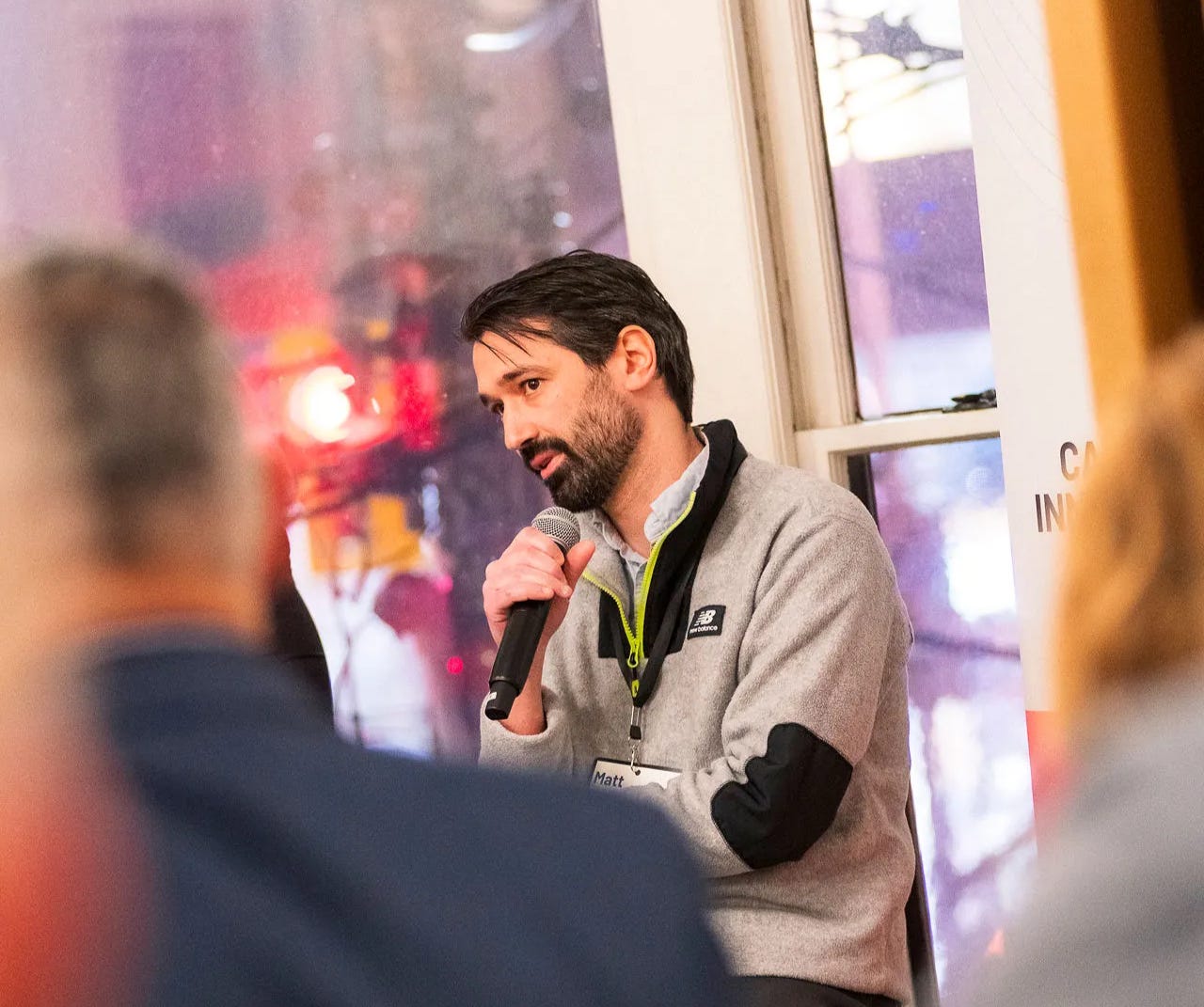
Matthew Lombardi is the co-founder of The Icebreaker, Canada’s defence innovation network and newsletter. He is also a director at ONE9, Canada’s first national security venture capital firm.

Through The Icebreaker, Lombardi has co-founded the Canadian Defence Investor Network with ONE9, launched Canada’s first defence tech hackathon, and recently produced a joint study with the BDC (Business Development Bank of Canada) on SME participation in defence. The mission is to make Canada a net exporter of defence technology by 2030.
Lombardi has personally invested in Canadian defence companies, including Dominion Dynamics and North Vector Dynamics. He argues that Canada already has the talent, stability, and resources to produce serious defence companies. What Canada lacks is a reliable pathway for companies to put their technology into the hands of Canadian troops.

During Startupfest 2026 in Montreal, I met with Lombardi to discuss what early-stage defence founders need to prove, Canada’s procurement problem, and whether more companies can reach Dominion Dynamics’ scale.
“I’ve invested in a Canadian drone company that found it easier to put their drones into the hands of Ukrainian troops than Canadian troops.”
In one sentence, what is The Icebreaker, and why does it matter for Canada?
“The Icebreaker is Canada’s defence innovation network. We’re focused on providing opportunities for startups working in the defence and dual-use space to have greater access to opportunities, ultimately to equip Canada’s Armed Forces. Our goal is to make Canada a net exporter of defence technology by 2030. The burning platform here, the real need, is that the nature of conflict has changed. The nature of the threat landscape has changed. The conflict in Ukraine really shows us that we do need frontier technologies for Canada to achieve a better level of deterrence.”
How do The Icebreaker and ONE9 fit together?
“I co-founded The Icebreaker just over a year ago. Through that Icebreaker network, we’ve done a lot of initiatives to build up the defence-tech ecosystem, from hackathons to proprietary data and research collection that fed into the DND Defence Industrial Strategy. More recently, we produced some proprietary data on defence financing that The Icebreaker did in conjunction with BDC.
Through these initiatives, I’ve been angel investing on my own as well. Sometimes I invested in companies that I’d known for a longer time; other times, I was angel investing in companies that I met through The Icebreaker. For example, I’m personally an angel investor in Dominion Dynamics. I’m personally an angel investor in North Vector Dynamics and a handful of other companies, some that you’d have heard of, some that are stealth, but all of which are Canadian sovereign defence tech. In the course of investing my own personal money and working on various initiatives through The Icebreaker, I started to run across Mike, Glenn and the team at ONE9. I just really liked them. I liked them first as people. I liked them as investors. I liked their investment philosophy. When I found out that they were raising a second fund, it felt like a really natural fit.”
How does Canada convert technical talent into companies and contracts?
“That is the multi-billion-dollar question. We do not have an innovation problem in Canada. What we actually have is a buyer problem. We need more pathways for Canadian companies to put their technology into the hands of our troops to get those iterative feedback cycles quickly.
I’ve invested in a Canadian drone company that found it easier to put their drones into the hands of Ukrainian troops than Canadian troops. That says two things. One, it says great things about that specific company, that they were willing to do what it took. But it says really bad things about the Canadian landscape for innovation that we have this incredible technology, and there’s just no pathway for our own military to buy it. That’s what we really need to change. It’s not about money. It’s not about innovation. It’s about pathways to procurement.”
What traits do you look for in an early founder?
“Great question. One of my favourite questions. In early-stage investing, when you’re pre-revenue, sometimes you’re just at the prototype stage. The TRL number might not be particularly high. It really is about: has this person built a great product? Will they do whatever it takes to get it into the hands of potential customers and users? Have they created an opportunity for themselves and their company to find a pathway to getting a buyer? For a lot of Canadian defence companies in the past, that has meant a foreign buyer. A different NATO military would be their first buyer. The ones who want to hustle and have been able to work at it successfully, in spite of our broken procurement system, have managed to do amazing things. We have an incredible history of military innovation in this country. What I look for is those three things and a combination of them that can really have a bias to action.”
30 Startups for a Sovereign Canada | Canadian30

Canada is recognizing the need for national sovereignty through hundreds of billions of dollars in generational investments, such as the Defence Industrial Strategy, the Canada Strong Fund, and its new National Artificial Intelligence Strategy. According to The Canadian Shield Institute, Canada's defence spending is projected to increase
What’s the number-one advantage that companies have by operating in Canada?
“There are so many advantages. We have an incredibly educated population, full of engineering talent, proximity to academic institutions, relative stability and peace in the country, which no one should take for granted with the way the world is these days. There is plenty of access to capital if you know where to look for it, and increasingly, Canadian institutions are starting to embrace defence, so there will be more capital. We have every advantage you can imagine. We just have to start to convert it into contracts for our own companies.”
Can Canada become a global leader in innovation?
“We already are a global leader in innovation. If you look at some of the most successful companies in Silicon Valley, a disproportionate number of them are founded by Canadians. We just need to be able to embrace that mentality here at home.”
Dominion just raised C$139 million. Do you foresee more Canadian defence startups reaching this scale?
“Absolutely. I think we’re going to see at least 10 to 15 Canadian defence techs achieve the same valuation or greater. And we have to. We absolutely have to.”

What is the most underrated national-interest niche?
“It’s not an underrated niche anymore, but for quite a long time, I’ve been trying really hard to learn about and pay attention to the quantum space, and specifically quantum cybersecurity. I think everybody is alive to the risks of what they call Q-Day, when quantum can sort of decrypt current internet cybersecurity writ large. It’s rapidly approaching, and I think a lot of organizations need to work hard to get prepared for it. It doesn’t just mean the military. It means critical civilian infrastructure, power grids, water-treatment plants, you name it. Q-Day is coming, and it’s an enormous risk.”
What do the next 12 months look like?
“I just started at ONE9, which I’m very excited about. It’s my third week on the job. My plan for the next 12 months is: one, we’ll close the fund; and two, there’s an incredible pipeline of Canadian companies that we’re looking to diligence and back.”
What’s one Canadian national-interest startup that you’re focused on?
“Right now, I’m strongly focused on North Vector Dynamics, which is Canada’s only precision-missile company out of Calgary. I was just in Calgary two days ago, meeting with them. Just an incredible technology, an incredible group of technical co-founders, and frankly, missile defence is a huge gap in Canada’s sovereign stack.”
If you’re building something in Canada, I want to hear about it. contact@ethanmarcoux.com
Vertical Takeoff Planes | Brandon Robinson — Explorer Spotlight #7

The Cavorite X7 is an aircraft that can take off vertically like a helicopter, fly forward like a plane, and recharge mid-air.

Great and positive changes are happening in the defense tech ecosystem in Canada; it's interesting to read about it.
A great question to ask is: how do we leverage defense tech as a dual-use innovation engine for the whole economy? I feel like many of the Canadian institutions that can supply the R&D talent could really help those entering the fields think in this way, so that the rest of the Canadian economy could benefit from this as well, and we can push innovation on all fronts.