


By Matt McLeod, Partner, Toronto | Blake, Cassels & Graydon LLP
Canadian defence is experiencing a generational moment of investment and support. By 2035, direct spending on the Canadian military alone could reach C$163.6 billion, up from C$29.3 billion in 2024–2025. As innovation accelerates and warfare evolves, global defence tech venture capital deal value has reached C$67.4 billion across 726 deals so far in 2026.
However, while the defence technology startup industry in the United States and Europe has expanded significantly since the invasion of Ukraine, Canada’s Defence Industrial Strategy, which opened the door to greater defence investment in Canada, was not released until February this year. Prior to this, military-related investment was largely restricted or viewed as undesirable across Canada.
Canada is now moving quickly to build a domestic defence startup ecosystem. BDC has launched a defence platform of up to C$6 billion, and the Defence Industrial Strategy aims to direct 70% of defence acquisitions to Canadian firms. There is no shortage of record-breaking raises being announced.
Founders who run a disciplined process can still raise capital. Here is how I would approach a pre-seed or seed round from a legal perspective.
1. Fix the foundation before you pitch
Given the sensitivity of the material and the extensiveness of regulation in the space, investors in defence and deep tech spend more time on structural due diligence than most founders expect. Before your first meeting, ensure that:
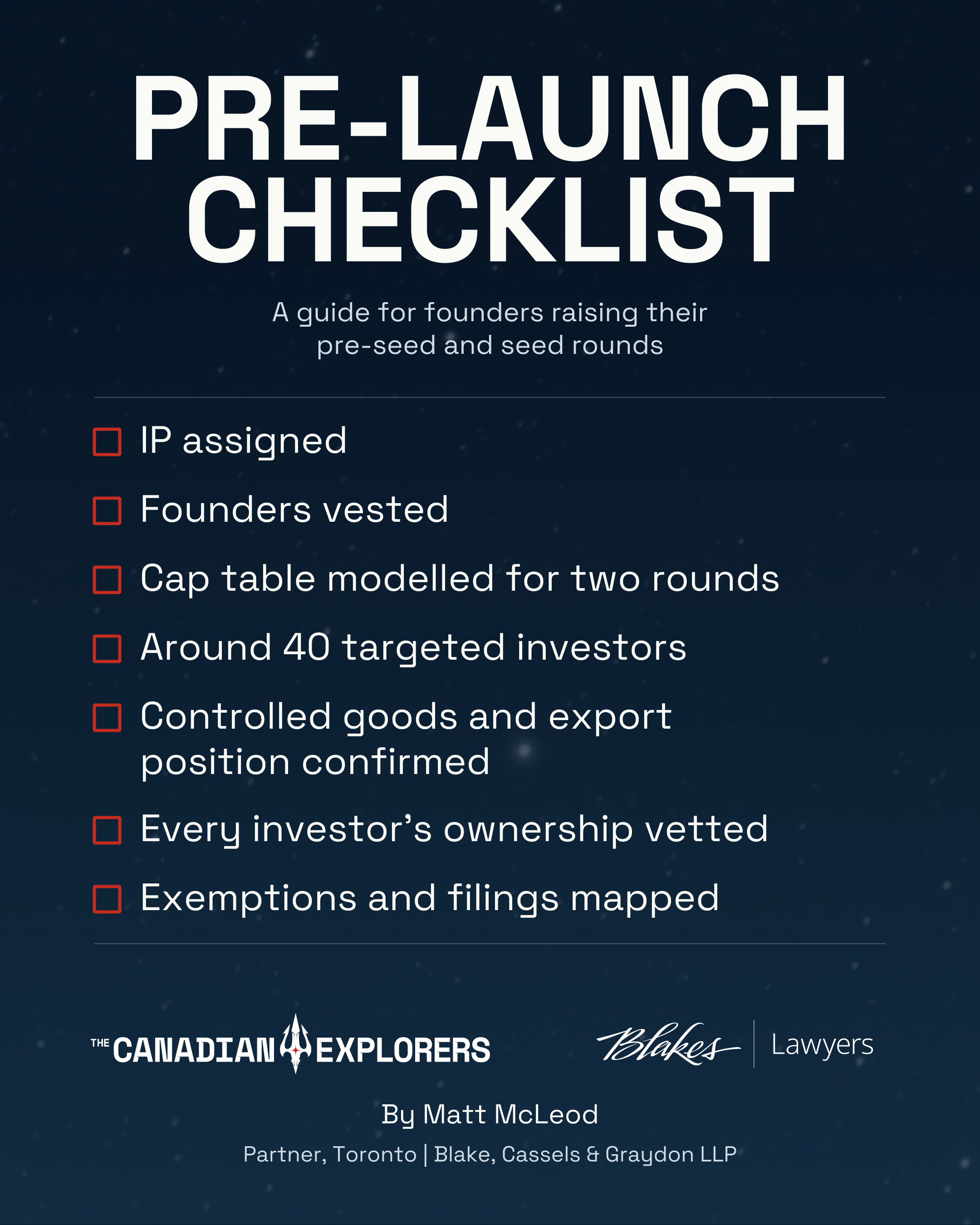
IP is in the company. Every founder and contractor should have signed an intellectual property assignment, which is an agreement that ensures all of the intellectual property is owned by the company, rather than its individuals. If the technology originated at a university, former employer or government lab, confirm in writing who owns it.
Founder vesting is in place. Vesting is the process by which employee ownership of shares is earned over time, rather than all at once. Typically, vesting is time-based or milestone-based, but in emerging companies, the time-based approach is most common. A four-year vesting period, with no shares vesting during the first year, is a common baseline. Investors will ask about it.
CCPC status is protected. Canadian-controlled private corporation status unlocks the enhanced Scientific Research and Experimental Development (SR&ED) credit (35% refundable on up to C$6 million of qualifying expenditures for most CCPCs). Foreign-investor control or a U.S. flip can affect that status, and some grant programs require a Canadian entity. Get advice before restructuring. While incorporating in a US jurisdiction can be favourable for many industries, in defence it can make a Canadian company less attractive to purchasers, given the push for sovereignty.
There is one clean data room. This should contain all corporate records, a capitalization table, IP assignments, key contracts and a simple financial model.
2. Choose your instrument and model the dilution
At pre-seed, most founders raise capital through a simple agreement for future equity (SAFE) or a convertible note. A SAFE allows for a straightforward legal process as you defer the valuation of a company to a later date – SAFEs are also designed to be founder-friendly, keeping founders in the driver’s seat. A convertible note is a debt instrument, which is generally more attractive to investors in early-stage companies, but the debt can convert to equity, making it more attractive to founders.
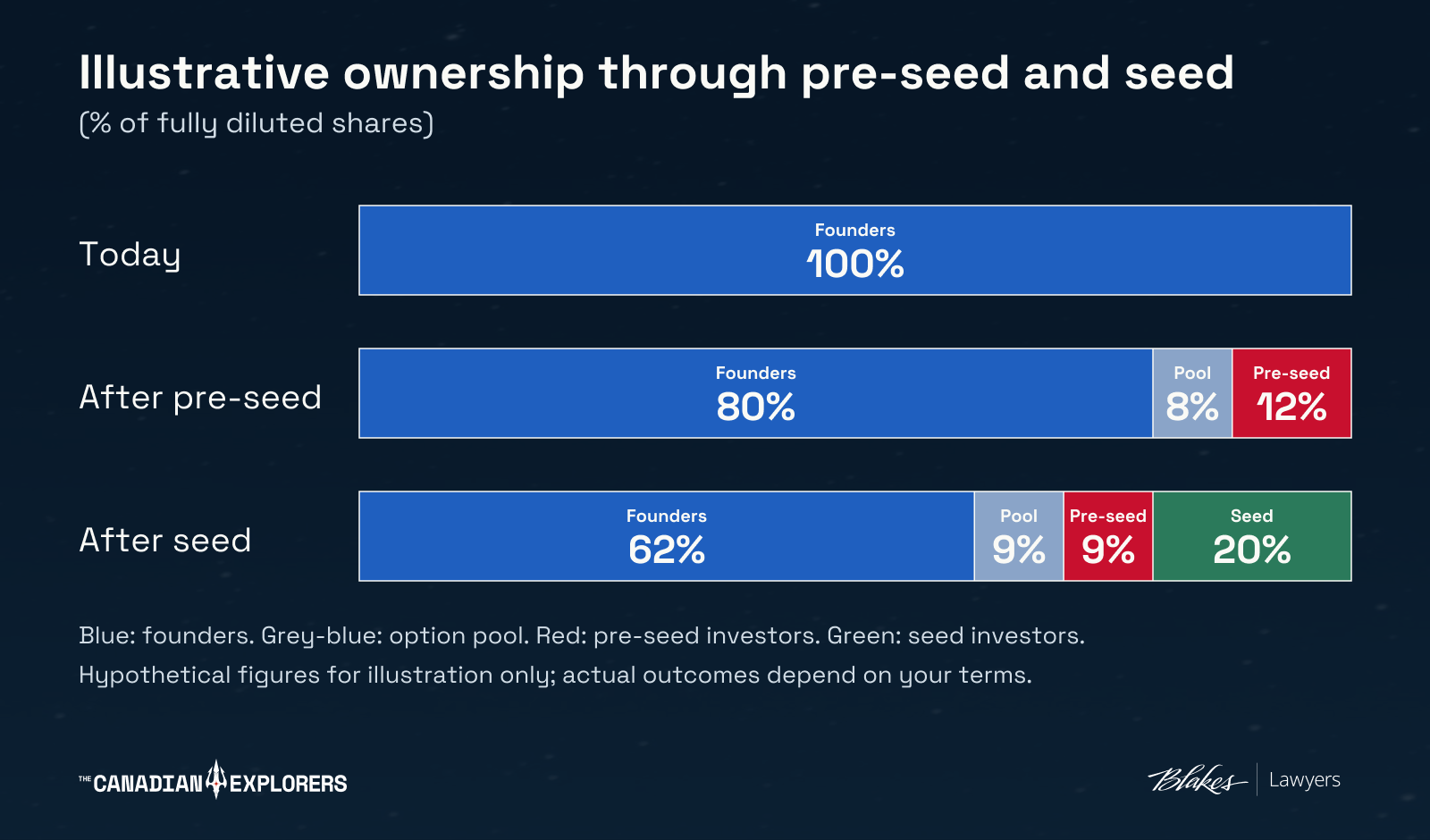
At seed, a lead investor will often push for a priced round of preferred shares. Whichever you use, the important terms are the valuation cap, any discount and how several instruments stack. Three uncapped or loosely capped notes can dilute your ownership far more than the headline numbers suggest. These numbers are important as they are the basis for how much ownership founders retain.
As a rule of thumb, plan to sell roughly 10–20% at pre-seed and 15–25% at seed, and reserve an option pool of about 10% for early hires. Build the cap table for both rounds before signing anything.
3. Build a targeted investor list
A scattershot list wastes months. Build five buckets and rank within each by evidence of defence or dual-use investing:
Specialist and defence-focused funds, such as BDC StrongNorth, Frostbite, NordSpace and ONE9.
Generalist early-stage funds with hard-tech appetite, such as Garage, Golden Ventures, Northside Ventures, Ripple and Panache.
Angel networks are often more open to defence at the earliest stage.
Accelerators are programs designed to help early-stage companies grow rapidly. These programs provide services, dilutive and non-dilutive funding, and other resources to help companies scale quickly.
Foreign dual-use funds can broaden the pool of available capital. Shopify’s Harley Finkelstein has urged founders to raise capital from anywhere once they are ready, and Dominion Dynamics’ Eliot Pence stresses bringing Canadian institutional capital in early. The best rounds usually do both. While keeping a higher percentage of Canadian ownership has advantages, getting the funding you need outweighs them.
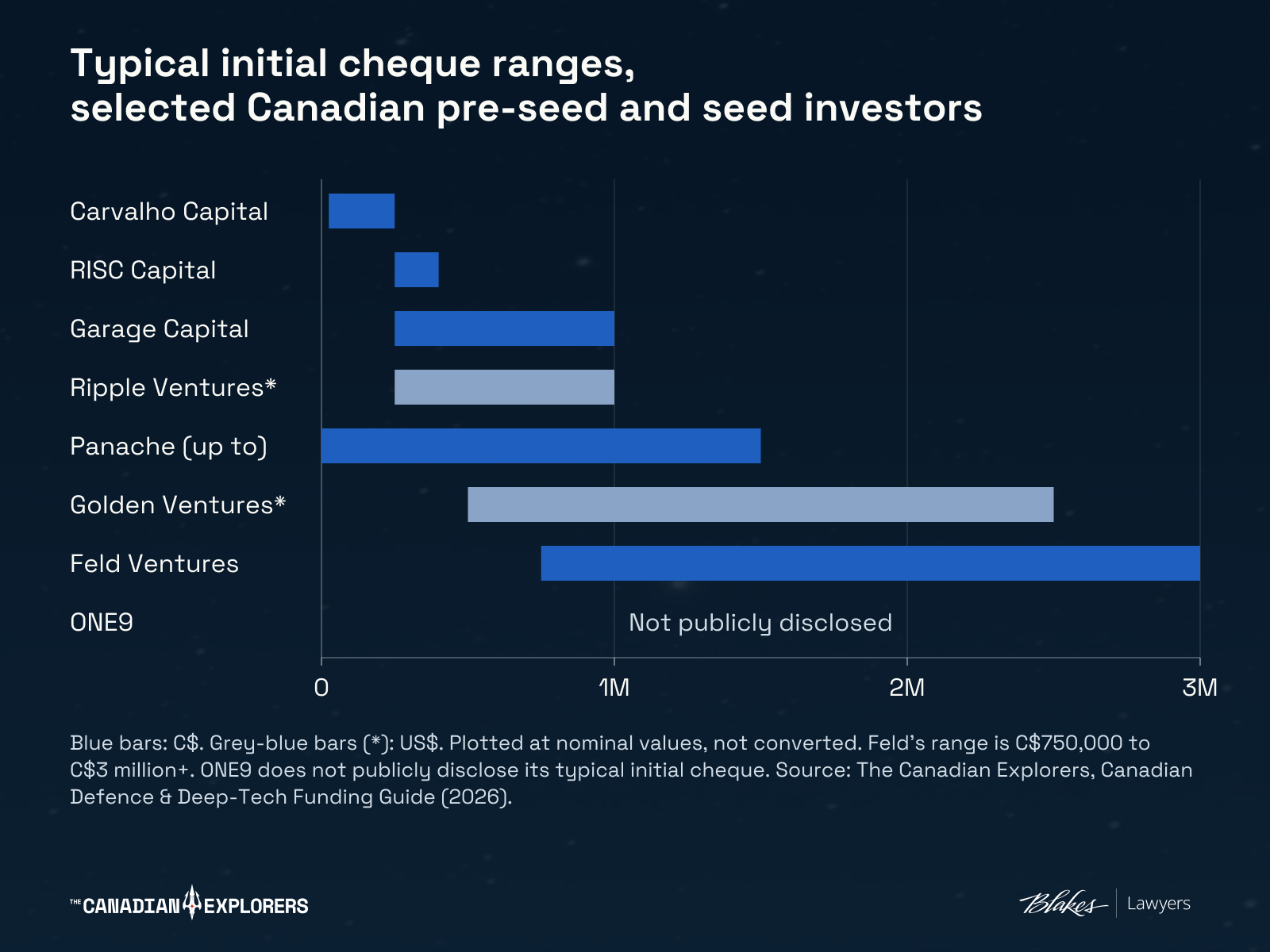
Funds typically specialize in a specific company size, so focus on groups that traditionally finance companies at your stage, and match the cheque size to your round.
A fund whose typical cheque is far above or below what you need is not a fit, regardless of its reputation. ONE9’s Glenn Cowan encourages founders to raise the amount their company needs at its particular stage of growth, rather than aiming for a metric generated by the hype cycle. Raising too much money can be a risk that some companies bump into – this can lead to overspending, your strategy being pulled in unintended directions, more dilution than is necessary and other inefficiencies that could drag your company down.
4. Stack non-dilutive capital alongside equity
Dilution is the process of giving ownership in your company for benefits, including funding or services. Non-dilutive funding both extends runway and signals technical credibility to investors. Canada is comparatively strong in this area. Consider:
Innovative Solutions Canada commonly provides up to C$150,000 in Phase 1 and up to C$1 million in Phase 2, with the company generally keeping its IP.
Innovation for Defence Excellence and Security (IDEaS) provides competitive funding for defence research and development, with phased awards up to C$6.75 million.
National Research Council of Canada Industrial Research Assistance Program, SR&ED and Mitacs offer advisory and project funding, tax credits and university-linked research support.
NATO Defence Innovation Accelerator for the North Atlantic (DIANA) provides an initial €100,000 award for selected dual-use companies.
Some programs reimburse costs after you spend them, rather than in advance of the initiative, and are tied to specific calls for proposals, so check which are open before you build them into your runway.
5. Be ready for defence-specific diligence
Expect these questions from investors, and from the Department of National Defence as a customer:
Controlled goods and export controls. If you handle controlled technology, you may need Controlled Goods Program registration, and export permits may apply. U.S.-origin technology can bring International Traffic in Arms Regulations (ITAR) into the picture.
Foreign ownership. The Investment Canada Act’s national security review can apply to foreign investments, including minority stakes. Vet every investor’s ownership and links before term sheets, and be careful with board seats and information rights.
Security clearances. Facility and personnel clearances are generally sponsored through a government contract. Security clearances can take months from start to finish, so plan the timing instead of assuming you can get them on demand.
Contract terms. Know who owns IP developed under government agreements and what restrictions follow. These agreements can be confusing, so it’s important to ensure you understand who retains ownership, licenses and use of the IP in question.
6. Stay inside securities law
There are comprehensive legal requirements when raising funds. The majority of emerging companies will look for an exemption to the prospectus requirement, without which raising money can be incredibly expensive and time-consuming. Raise under a prospectus exemption, most commonly the accredited investor or private issuer exemption. In most provinces, you must file a report of exempt distribution (Form 45-106F1) within 10 days of closing. Avoid broadcasting the round publicly. If U.S. investors participate, ensure that a U.S. exemption is also available. Taking investors who do not qualify can create rescission rights down the road.
7. Run a tight, time-boxed process
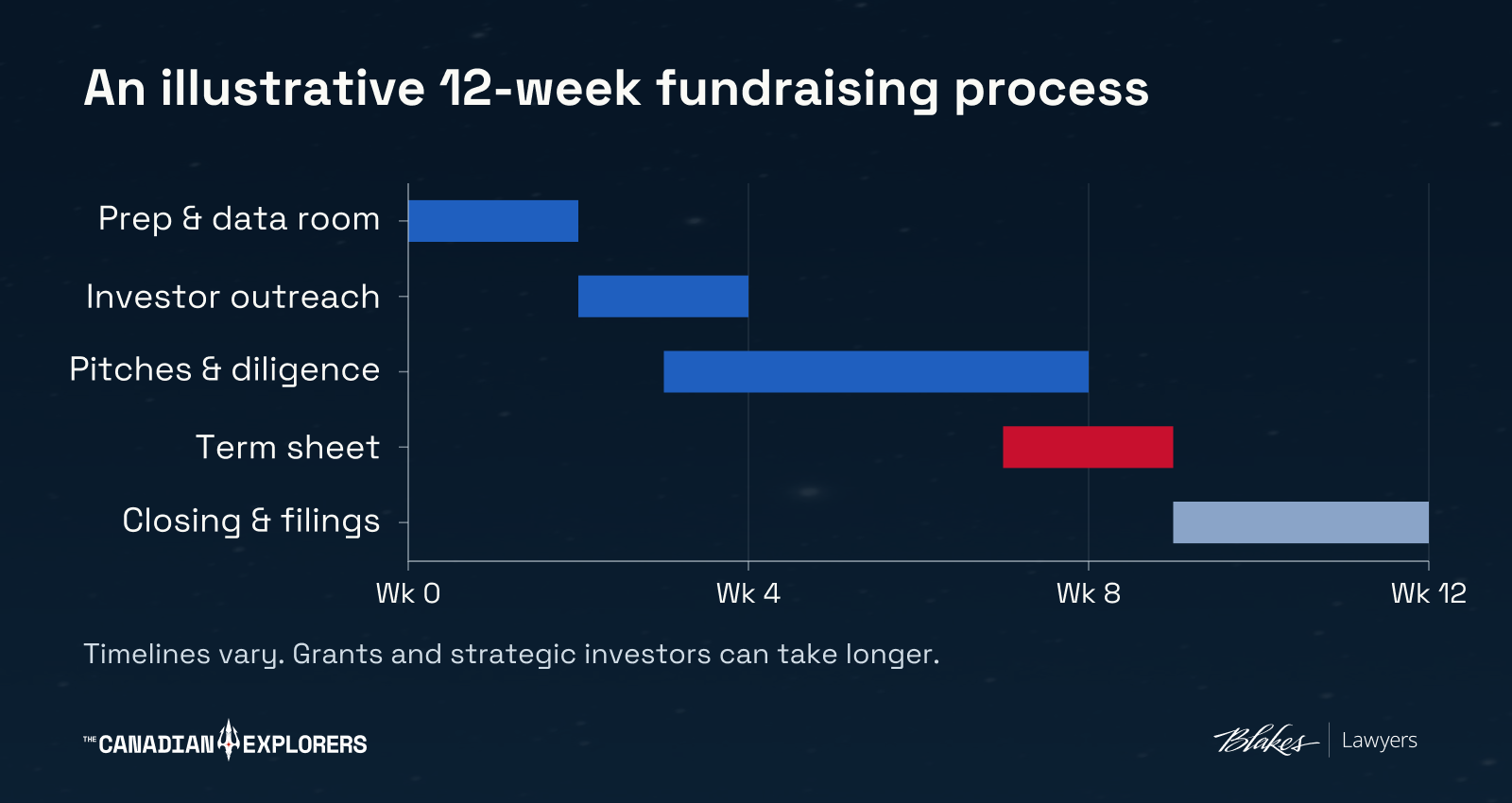
Momentum matters. Compress meetings into a few weeks so investors see competing interest, and target 18 to 24 months of runway—or longer if you are building hardware. There is the added benefit of allowing founders to get back to focusing on building their product if timelines are compressed.
Pre-launch checklist
Raising a first round in defence and deep tech is as much about preparation as persuasion. Founders who arrive with a clean structure, realistic terms and a clear understanding of regulatory risk typically close faster and on better terms, meaning less dilution and more ownership, and more capital to build with.
About the Author

Matt is a Partner in the Blakes Defence group. His practice focuses on mergers and acquisitions, venture capital and corporate law, with a particular emphasis on the defence sector. Drawing on his background in technology and engineering, he advises emerging, high-growth and established companies on strategic transactions, investments and corporate matters.
For more information, please contact Matt or any other member of the Blakes Defence group.
Blake, Cassels & Graydon LLP
As one of Canada’s leading business law firms, Blakes advises companies across the defence ecosystem through a multidisciplinary team that combines legal excellence with firsthand military and government experience.
This article provides general information only and is not legal advice. Investor mandates, program terms and regulatory requirements change; confirm current details with each organization and consult counsel before relying on this guide.
Partners of The Canadian Explorers

The Canadian Explorers works with a limited group of sponsors that support the founders and startups solving Canada’s most difficult problems across defence, deep-tech and other critical industries.

Such a valuable guide! It's full of useful information without being too wordy.