


In war, disasters, and remote conditions, the demand for medical supplies rises when supply chains are most likely to fail. Since Russia’s full-scale invasion of Ukraine, Ukraine’s Ministry of Health estimated that 100,000 war-related amputations had been performed by mid-2024.
Building Bloc Systems is developing a decentralized platform for medical manufacturing, designed to make production faster and cheaper in austere environments such as war zones, disaster response, remote and low-resource communities, post-conflict recovery, and the Arctic. The company is assembling factories which can produce medical devices, consumables, surgical instruments, and replacement parts at the point of care, where a custom prosthetic can be produced in as little as 22 minutes. This reduces the need to predict and ship every item frontline healthcare teams may require. Its hardware can range from suitcase-sized field units to ruggedized container factories and permanent manufacturing facilities.
Building Bloc is working with Ukraine’s Ministry of Veterans Affairs on a proposed network of prosthetics manufacturing sites. It estimates that four factories could add capacity for approximately 15,000 prosthetics per year.
Founded in 2024, the team is led by CEO and founder Dr. Harvey Hawes, an experienced trauma surgeon with 20 years in trauma care and health-system development across Canada’s North, Fiji, and East Africa. He currently works clinically as a civilian trauma surgeon and serves as Provincial Trauma Medical Director for British Columbia. He describes Building Bloc as the “factory that builds factories that build products.”
I spoke with Hawes about rebuilding medical supply chains, designing a company for both defence and civilian healthcare, and manufacturing what patients need where they need it.
In one sentence, what is Building Bloc building?
“We’re building a decentralized platform for regulated medical-device manufacturing that will allow our customers to have medical-supply certainty.”
When did you realize microfactories had to exist?
“I spent six years as a humanitarian surgeon, working in places that had a lot of donated equipment. There were these massive graveyards of unusable capital that just needed repair. At the time, additive manufacturing was just coming on board, and I started thinking we could rehabilitate this wasted capital and try to solve some of the inequity in healthcare that I was seeing from low-resource centres to high-income countries.
Then I was doing some humanitarian mission work and some combat work, and I was seeing that it’s not the pointy end of the spear all the time. Although funding and interest are going towards defence spending and defence innovation like drones and weapons, what happens after that, or even during prolonged engagements, is really important too for the communities, the civilians, the governments, and the economies after war. Rehabilitating health infrastructure became really interesting to me, both during acute combat operations and in the immediate aftermath. Deploying medical manufacturing specifically geared to rehabilitate health systems was the first real interest I had in this.
Then, as additive and other technologies got better, and software became easier to integrate, I started thinking about the real supply chain: actually making the stuff that you need to provide healthcare anywhere in the world, to really get over those inequities that I was seeing. It came full circle back to more of a humanitarian aspect, but certainly it touches on disaster management and defence, which I believe in.”
How does it work? What can it manufacture, and at what scale?
“We’re designing very small, agile, mobile, almost suitcase-sized manufacturing systems that, with the right software and training on top of them, could make some medical devices or repair equipment in the field. That’s really the use case for the very agile units or for supporting special forces operations.
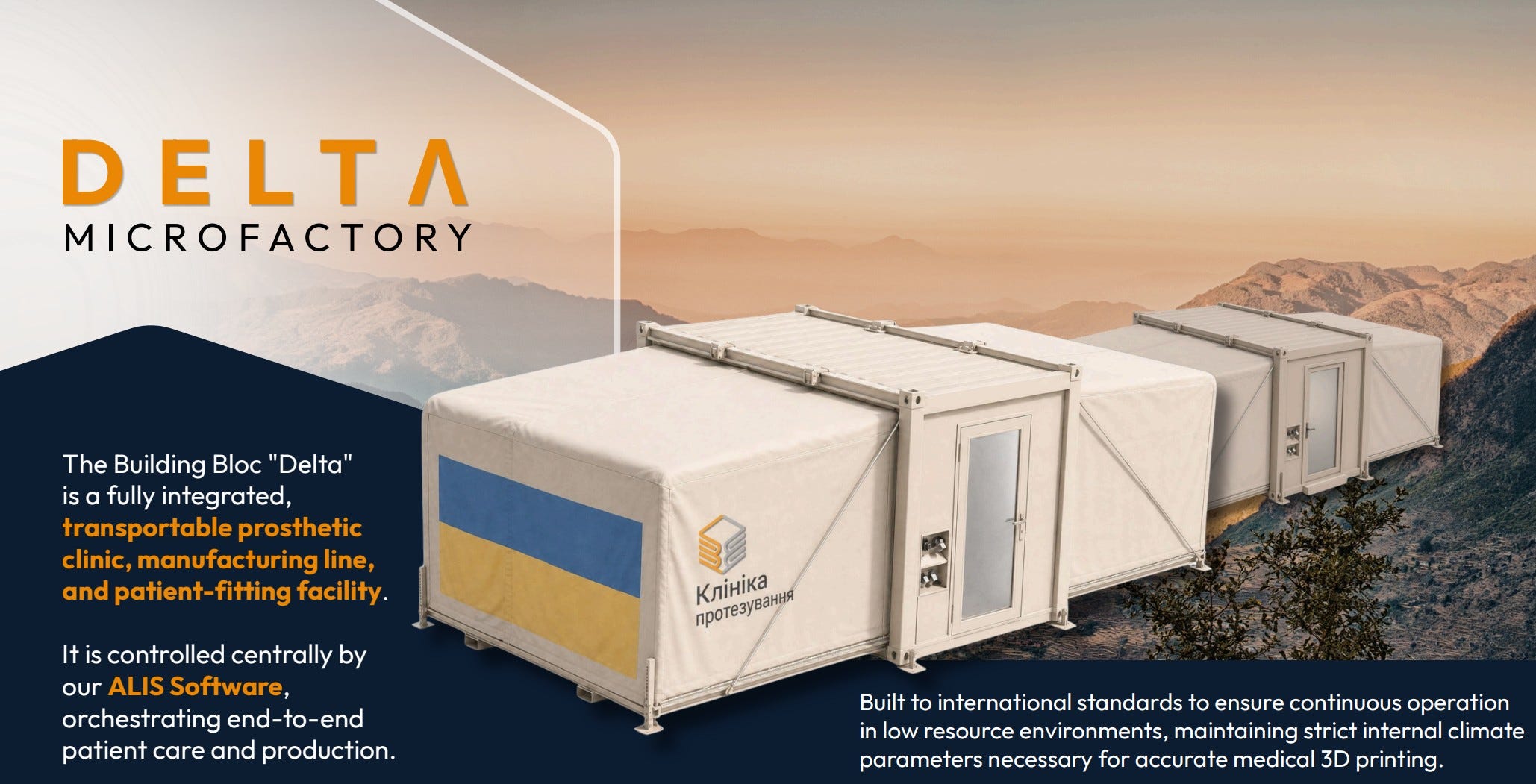
Then we can scale up to standard shipping-container-sized units. Those can make medical-device consumables, surgical instruments, and things that you need in remote or austere environments for the types of medicine that you need to perform there. They can make about 75 percent of what’s needed to really cut down on medical-supply-chain complexity. You just need to ship precursor material, and you can make many different things from a digital catalogue, versus trying to package everything you think you need.
Those facilities can make thousands of parts per day. You can support operations at a small- to mid-sized mobile health facility, maybe disaster response or a Role 2 NATO-style facility. That’s the deployable side. They don’t have to be containerized, mobile, or agile. They can be on factory floors, and you can design bespoke factories to do high-volume, more traditional manufacturing as well.
The software is the key that links it all together. It orchestrates multiple units around the world into a supply chain. You can do things like load balancing, sensing, and demand matching. It’s designed to be scalable. It’s the same platform, but the location, size, scale, and intended use change.”
Is the containerized platform the main product offering?
“It was the main initial product offering, for sure. But as we understood our customers more, not only defence customers but the civilian market as well, onshoring sovereign manufacturing for healthcare in Canada is a big deal. We import 70 percent of our medical devices here, and most countries import at least that much, some of them more. Being able to produce at a national scale is really important, and our system lends itself to that. Remote, rural, and Arctic places would need more of the containerized, ruggedized footprints that we have.
3D printing is just one modality of manufacturing. Any digitally controlled manufacturing process can be incorporated into our software system. The main focus of the company is to build that integrated software system, put digital work instructions into it, put training and regulatory management into it, and orchestrate multiple units across geographies.
3D printing is a natural fit because, with a limited number of feedstocks such as resins or filaments, you can print thousands of different things. It’s a lever that you can use for manufacturing. It’s not the best manufacturing method, nor do we think it’s going to be the only one we use long-term, but it’s one of the tools we use. There are many others. The company is software-first, with hardware to be integrated. That could be on-table injection moulding, extrusion, or CNC. When you combine those modalities, you can make quite a bit, pretty quickly.”
Where is the technology today?
“We started the company in December 2024, so we’re fairly new. We’ve built our first factory that’s making our first factory. We’re a factory that builds factories that build products.
Our first factory is in Burnaby, B.C., and we’re building our prototype containerized unit for demonstration and validation. Our medical-supply manufacturing product is at technology readiness level 6 (TRL 6) right now. When we deploy and validate, which we’re planning to do in the winter with civilian use cases in Northern B.C., we’ll hit TRL 8 at that point. That will be the unit that we go around and show to defence customers and healthcare customers.
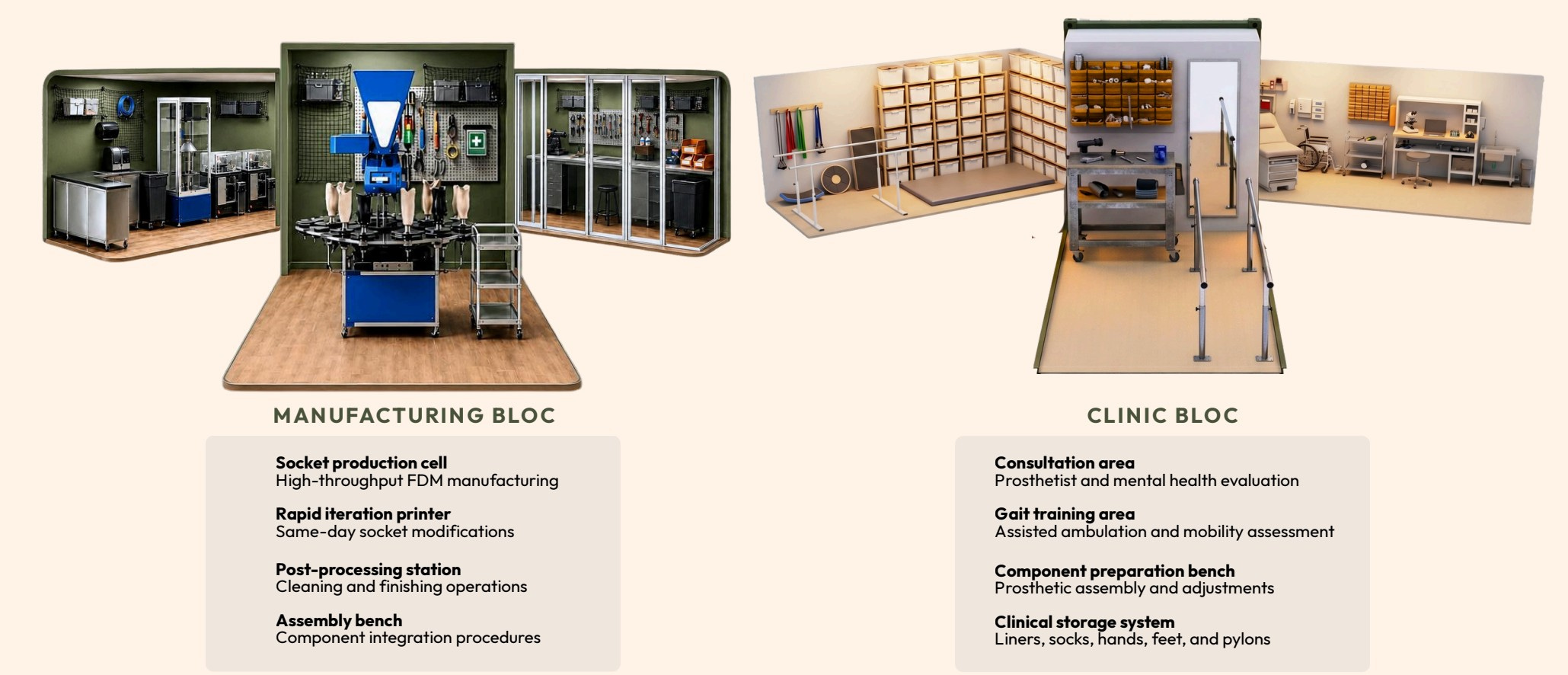
We have another deployment opportunity in East Africa that’s being developed. That will be the same kind of thing in a different country, to validate it in a different context. One of the projects we’re developing is a network of mobile prosthetics clinics and factories for Ukraine and other countries. We’ve been working with the Ukrainian government on designing the system. The mobile prosthetics clinic and factory system is currently at TRL 8, and the first unit could be in-country within nine months of an order.”
What does the MOU with Ukraine’s Ministry of Veterans Affairs cover?
“During the Invictus Games in Vancouver last year, one of our champions in government invited the Minister of Veterans Affairs from Ukraine and the ambassador’s office to visit us in Vancouver as part of their tour. Ukraine was showcased at the Invictus Games. We understood the need for prosthetics. I trained as a war surgeon, and I know that amputation rates are incredibly high right now in Ukraine. From the modern face of war, it’s more of a maiming war than a killing war. If soldiers or civilians have amputations and don’t get prosthetics early, then they are placed on the sidelines or become a burden to their families or the economy. With new prosthetic technologies, it’s possible to provide prosthetics early, manufacture them at scale, and manufacture them custom. Traditionally, they’re hand-formed. People have to wait several months, if not a year, in some places in Ukraine, to get a prosthetic. If they get them late and the limb has atrophied, they don’t have the same functional outcome.
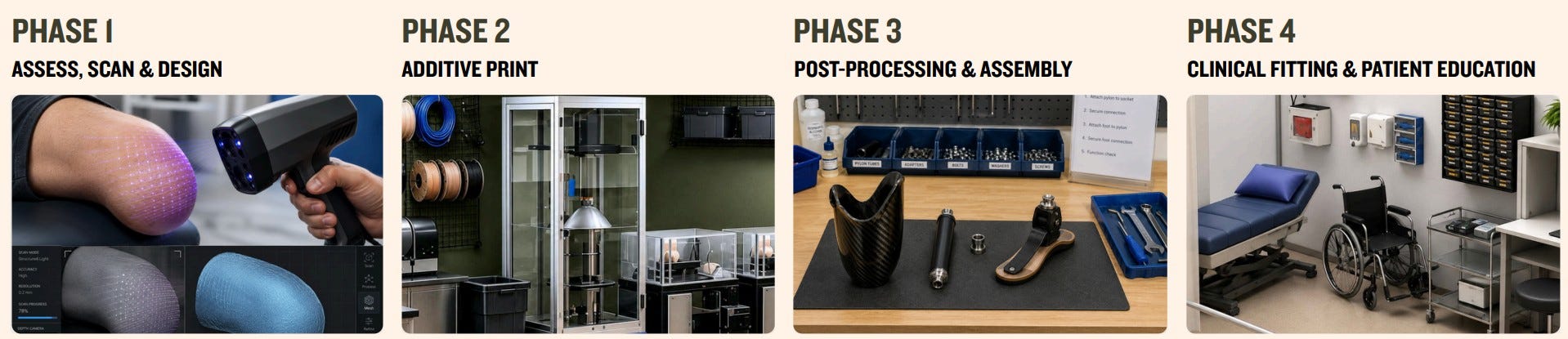
Using 3D scanning and 3D printing for portions of the prosthetic, you can do it quite rapidly: taking a six-month waiting list and turning it into one day, where you see the patient, scan the patient, fit the patient with the prosthetic, and get them on the road to recovery essentially right after they leave the hospital from their amputation. That’s going to have better functional outcomes and better economic outcomes for Ukraine. When they came to visit us in Vancouver, we made them a custom prosthetic in 22 minutes and handed it to them. They said, “This is the kind of thing that we need. How many can you make?” We designed our system to double the annual prosthetics capacity in Ukraine at the time, which was about 15,000 prosthetics per year. We could add 15,000 prosthetics with four of our factories deployed.
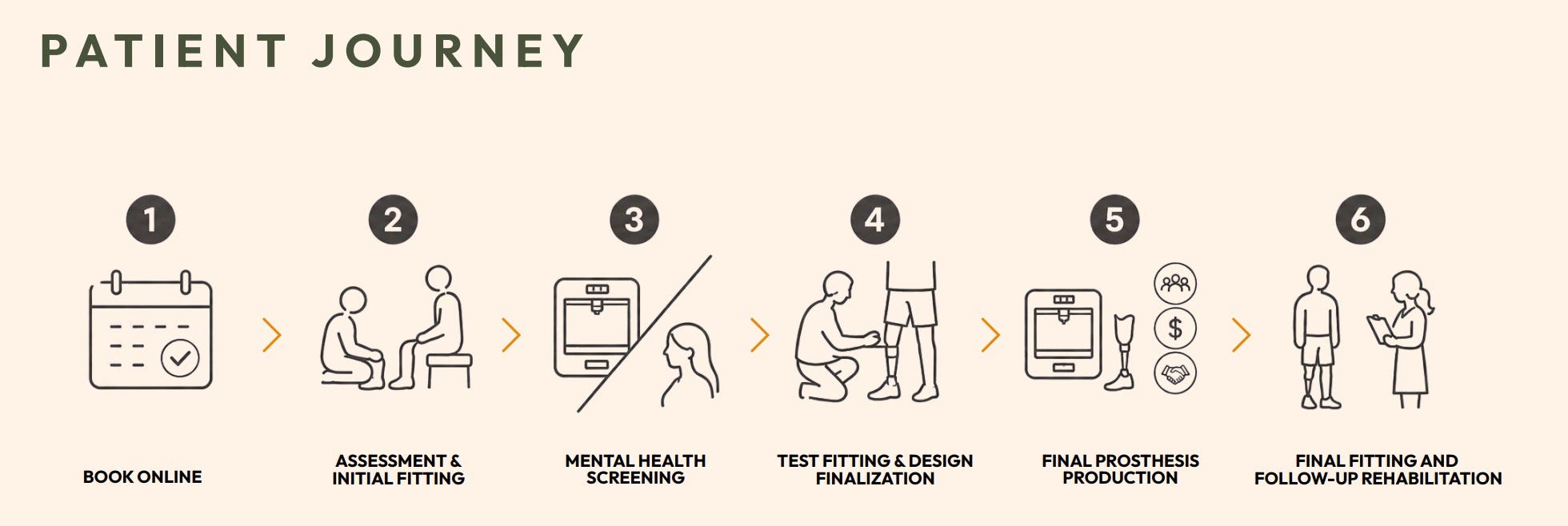
We can move our factories around. One of the struggles they have is access for patients who live in the east. Travelling across the country is challenging, especially if you’re a new amputee. Being able to move the facilities where they’re needed was of great importance to the minister. They liked what we were doing, and we chose to explore it further. We have an MOU that is basically to develop the system and seek funding support to deploy it. We’re going through the Canadian government’s available Ukraine-assistance funds. We think this would be a great way for Canada to support Ukraine without sending weapons or drones, but by helping with the rebuild and helping civilians and soldiers get back to life. We’re very close to that. I think we’re likely to have significant support from the Canadian government and be able to bring this to Ukraine to have a real impact there: a Canadian-led innovation and an all-Canadian team delivering something for the citizens of Ukraine.
How is a defence customer different from a civilian healthcare customer?
“There are some similarities. Civilian healthcare around disaster management and disaster response is probably the most similar to the defence customer base. Defence expeditionary forces and responding to an earthquake or wildfire are, from a logistical standpoint, similar. But civilian healthcare is very restricted in terms of dollars. The adoption barriers in the civilian healthcare world are very different from those in defence.
Defence, especially nowadays, is much more innovative and much more willing to change as they see the face of war changing quickly and looks for solutions to adapt. We see the synergy for a company like ours that’s dual-use from the outset. We’re not a dual-use company that’s dabbling in defence or dabbling in another thing. We were built that way from the beginning. Leveraging the defence spend and the defence-innovation drive that we’re seeing now, then building off that to showcase a more advanced product to healthcare, which is much slower to change, is really important. That should help us gain adoption in healthcare.
Then that cycle will come back to military medicine as well. As healthcare adopts it and physicians are trained on it and start to understand it better, those physicians go into the military and naturally bring the technologies they want with them. This could be one of those. We see it as a circle.”
30 Startups for a Sovereign Canada | Canadian30

Canada is recognizing the need for national sovereignty through hundreds of billions of dollars in generational investments, such as the Defence Industrial Strategy, the Canada Strong Fund, and its new National Artificial Intelligence Strategy. According to The Canadian Shield Institute, Canada's defence spending is projected to increase
What’s one trait you think a founder needs to succeed in this market?
“Be a glutton for punishment. It’s horrible. This is not consumerism. This is not building an app. Both aspects of what we do are highly regulated.
Regulation, probably rightly so, scares off a number of startups because it is complex. But it’s also deterministic. You can understand the regulation and solve for it. It’s really a documentation and engineering challenge. If you’re willing to be patient with it and build that in from the outset, then it’s no different from any other challenge that a startup faces. The real struggle, and it’s changing but hasn’t quite changed yet, is adoption, funding, and procurement. You hear that from every startup, and they’re probably the worst in defence and healthcare.
You have to be in it for the long haul. You probably need the right connections from the get-go, or need to find people with the right connections who believe in your product. Otherwise, trying to be a startup and sell to healthcare, governments, and defence is really, really hard. I think mostly impossible.”
What’s the biggest obstacle preventing you from scaling right now?
“Just capital.
I’ve worked in the U.S.; I spent some time in the U.S. and trained in the U.S. as a physician. It’s not where I want to focus my efforts or innovation. From a pure business standpoint, if I were in this company to make money, then obviously I would have gone to the U.S. a while ago, raised money, and worked in that market.
But I really want to build capacity for Canada. I think Canada could be an innovative country. It’s moving in that direction. We see the need, and we seem to have this new nationalism, in a healthy way, that shows we have what it takes to succeed in the global market. I want to be part of that.
It’s not about politics or what’s currently happening south of the border. Building up Canada’s innovation ecosystems is where my heart lies. We’ll stay here, but it’s also hard because we don’t have the capital infrastructure. The innovative spirit is slowly coming around, but it’s not there yet. The adoption and government-procurement cycles are very limiting.
Those are the barriers. But the promise is that we’re a highly educated country and very diverse. We see needs globally, outside of just the neighbour to the south. Products that address global concerns are often supported by the federal government; that’s a big plus for me because I came from a humanitarian-surgery background, and that was why I started this company. I don’t think I would have gotten that in the U.S.”
What do the next 12 months look like for Building Bloc?
“Continuing to build out the proof point. The R&D is largely settled. We’ve addressed the major hurdles and the regulatory hurdles. We have a roadmap to finish the software and the demonstration units. It is such a foundational change in the way healthcare systems work. Typically, you procure what you need from distributors and large manufacturers. If you need a repair part, you put in a request and wait three or four months.
What we’re saying is that you don’t have to do that anymore. If you need something, you take it off the shelf, and our system replenishes that stock. If something is broken, you make the repair part on site within a day.
It’s a new way of thinking. Healthcare systems don’t understand that. It’s not really in their lexicon to manufacture what they need. Showing that this is simple, easy to use, guided, and safe is the hurdle to adoption. That’s what we’re doing in the next year: building those demonstration models to show that this is something they can do.”
What is one other Canadian national-interest startup worth watching?
“I mentioned Sentinel R&D, but the other one that really interests me, and it’s also local to B.C., is FireSwarm. It’s another real dual-use company that has a great civilian impact. They build super-heavy-lift drones that carry water and can service wildfires almost autonomously. It’s incredible. Those airframes, that use case, and targeting it with surveillance systems and multiple data sources are really cool. I like what they’re doing. The list that you have includes many of those companies. I think they’re great too.”
If you’re building something in Canada, I want to hear about it. contact@ethanmarcoux.com
Canada's First National Security VC | Glenn Cowan — Explorer Spotlight #3

ONE9 is Canada’s first national security venture capital firm. It was founded in 2013 by Glenn Cowan, a former JTF 2 (Joint Task Force 2) Squadron Commander in Canada’s special forces. In 2025, ONE9’s venture capital business was acquired by Kensington Capital Partners


Excited to read this later tonight.