


The once-ignored Canadian defence industry is being pulled into the spotlight through Canada’s Defence Industrial Strategy. A new generation of founders is entering the arena, many of whom have never built a defence product before. While this moment represents a new awakening, there is a group of founders who have managed to build when the conditions were not so glamorous.
CEO and Founder of Anvil, Samuel Witherspoon, has been building a sovereign defence company in Ottawa for over a decade. I asked him a few questions on the floor of CANSEC about his perspective on this opportunity.
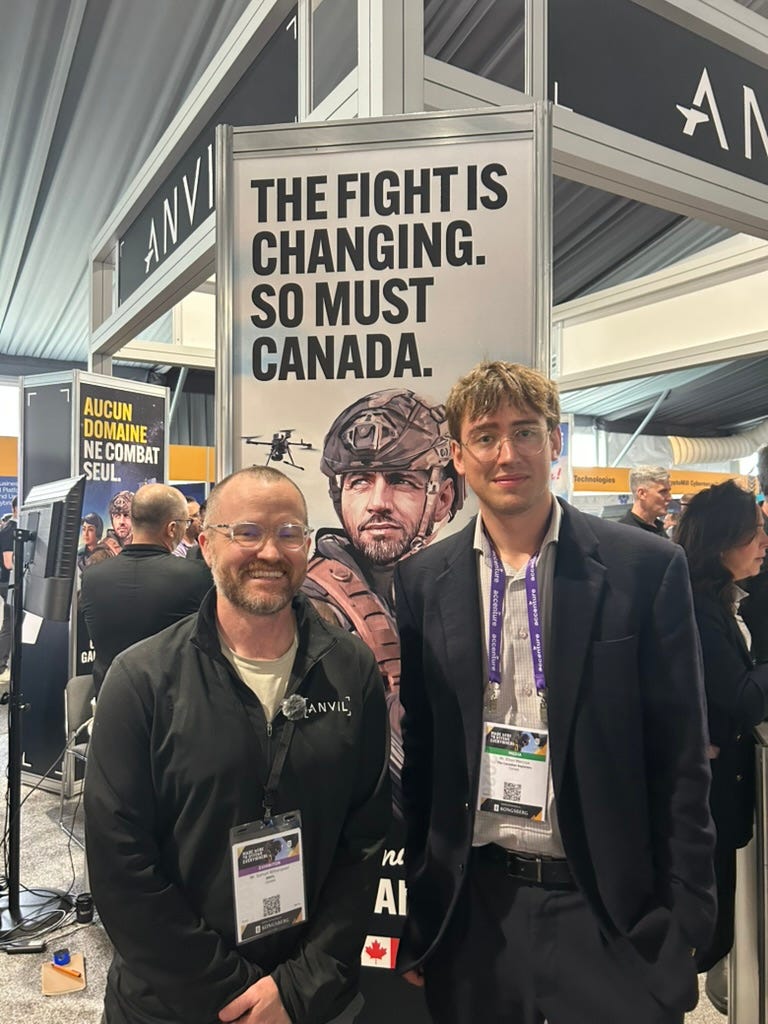
In one sentence, what are you building, and why?
“At Anvil, we’re building a sovereign data platform that brings information in a variety of form factors into one place. Makes it exploitable for intelligence operators, military planners, logistics folks, right across the sort of military operation and planning cycle. Why are we building it? We’re building it because, over a decade ago, I experienced some of these very problems while I was working. The conclusion I came to was that there was a massive capability gap in the market, and I thought I could fix it.”
What’s one trait you think a founder needs to succeed in this market?
“One trait founders need is persistence. When I first started, my grandpa bought me a plaque, a quote from Calvin Coolidge. It goes through things like educated men with no job are a proverb, a whole bunch of statements about things you need to be wary of. But it ends with the idea that persistence is omnipotent. And I think the message he was trying to send me, and continues to send me, is that it doesn't matter what your education is; you're not entitled to anything. The only thing you're entitled to is to persist. So founders need persistence. There's no such thing as an overnight success story.”
![Nothing in the world can take the place of persistence." - Calvin Coolidge [2266x1731] : r/QuotesPorn](https://substackcdn.com/image/fetch/$s_!14ZN!,f_auto,q_auto:good,fl_progressive:steep/https%3A%2F%2Fsubstack-post-media.s3.amazonaws.com%2Fpublic%2Fimages%2F58fc0579-441a-498f-a4d3-c102dd4814df_2266x1731.jpeg "Nothing in the world can take the place of persistence.\" - Calvin Coolidge [2266x1731] : r/QuotesPorn")
What is something that new founders are getting wrong?
“We are bootstrapped. We’ve never raised capital. And so one thing I think founders are getting wrong is that they feel like raising money or going out and participating in the venture economy is the only path to getting things done. As opposed to recognizing that, growing out of revenue, growing through sales is actually not just a viable path, but in some ways a less stressful and less adversarial path where you’re the master of your own destiny. You get to choose what you want to work on and how you want to work on it. The benefit is you get a lot more autonomy and retain a whole bunch more control.”
What challenges are Canadian SMEs currently facing? Can bureaucracy be pushed aside?
“Yeah. So I think I’m going to challenge some of the premises of the question. The bureaucracy itself, some of it is unnecessary and overly cumbersome. But some of the bureaucracy is necessary. We work in an industry that is necessarily highly regulated. We work in an industry that is quite literally life or death in some circumstances. We work on very serious problems of national and international consequence. So there is this level of regulation, and there is this level of scrutiny and oversight. We’re working in a highly important, highly regulated industry, and so coming in and complaining that there’s too much bureaucracy. There’s too much oversight. I’m not necessarily sure that they’ve got the balance right, if they’re complaining. Maybe they do.
What are the challenges that are caused by the bureaucracy? I think at times there are too many stakeholders. People who understand and hold the requirement are unequivocally the Department of National Defence and the Canadian Armed Forces. But then there are a whole bunch of other organizations within the government that believe they are an equal and valuable stakeholder, and sometimes they are. But oftentimes, they use that to leverage their way into speaking on the requirement that DND, CAF holds. And I think that is where the bureaucracy gets in its own way.
The balance between speed and regulation
The requirement holder is ultimately the warfighter. What the warfighter needs, the warfighter should get. There should not be a whole bunch of other people saying, well, actually, I think we should soften this requirement or modify this requirement. That is where the bureaucracy does itself a disservice. Challenging the premise that we shouldn’t have all these regulations, I think in general, some of this regulation is necessary. We’re talking about weapons systems. We’re talking about international traffic in arms. If you want to sell a weapon system in Canada or overseas, you should endure a heightened amount of scrutiny. If you want to handle highly sensitive information, you should endure a higher level of scrutiny and compliance obligations.
All other things being equal, I think a good chunk of regulation is justified and required. When you meet the people who are doing that work, they’re not trying to obstruct because they find it fun. They’re doing it because their job is consequential and getting it wrong is quite literally life or death. There’s a balance to be struck. Where that balance is… I’m sure we can move faster in some areas, but I’m not all about, you know, tearing the system down to the studs and building it back up. I think that there are so many mission-focused, mission-oriented people who are working in the system. I’m optimistic. The system has its flaws, but is, overall, you know, doing the right thing for the most part.”
Do procurement timelines need to be sped up?
“So I think there’s a difference between procurement timelines and the time it takes a requirement to be identified and put out for procurement. I think the difference there is subtle but important. Procurement timelines, if an urgent requirement emerges, there is a very clear pathway to going from that urgent requirement emerging to purchasing. Does it move as fast as anyone would like? Sometimes, sometimes not. You know, we’ve had contracts that have moved very, very quickly. Within days from the requirement to the contract close. We’ve had other contracts that have taken 16 months. That process, I’m reluctant to say, is entirely broken.
What I do see is requirements that are defined a decade or two decades previous, where the procurement process and the requirements definition, the request for information, all of the preliminary steps that go towards ultimately issuing a tender, gathering responses, and buying the thing, those processes are onerous, long, and by the time they hit the street, the actual requirement is so antique that we’re buying yesterday’s technology tomorrow. That process needs to change, where requirements are identified quickly, the procurement is initiated, and the public competition occurs. All of that timeline needs to be compressed. And I think taking a more iterative and incremental approach, as opposed to these giant Franken-procurements where we spend billions of dollars on a system integrator whose job it is then to go and find the different parts and bring them together. That’s an old way of doing things, and I think there’s a lot of room to change how that works.”
After building for over a decade, what is your plan for the next 12 months, given the hype?
“Our plan is probably distinct from a lot of the other companies that are trying to enter the space. We’re already in the space. We’ve already been delivering capability for DND and CAF for a long time at this point, and so we plan to continue to run the way we have run. That’s, focus first and foremost on delivering capability that matters. Letting our actions speak louder than our words and showing up for the warfighters, showing up for the men and women in uniform and making sure that if something needs to get done, it gets done, whether it’s within the construct of the platform we build or whether it’s just making sure everyone has a hot cup of coffee at 8 in the morning. We want to be that valuable, good partner. That’s been how we’ve operated for over a decade, focused on making sure that the people who are doing the work, who are doing the hard stuff. And making sure that their lives are as easy as humanly possible, with the knowledge that we build software at the end of the day. You know, we’re not living in tents, although we do at times. Our job is to minimize the stress, minimize the worry that the operators have.”
What other Canadian national-interest startups are worth watching?
“Two that I’ve worked with for a long time, good friends with both the founders, H2 Analytics, and TACTIQL. So, Hugo Hodgett and Mike Nelson have both been determined founders, working diligently and persistently at breaking into the market, but then they’ve been in the market for several years at this point as well, delivering effect. We share a lot of the same values. We’re focused on how to get effect delivered for the warfighter as fast as possible. And so, really proud to get to work with guys like that, and I think they’re two to watch.”
Why are you building in Canada?
“Well, I’m building in Canada because it’s where I’m from, it’s the country that I love, and so, I wouldn’t want to build anywhere else, first and foremost. But I think for a bunch of us who have either worked alongside DND, CAF or served within it. I think the reality is we feel a deep loyalty to go back and improve the systems and the processes that we came up under, or have worked within. Getting that opportunity to go back in and contribute, even if we’re not in uniform, that’s why we’re building in Canada, and that’s why we want to keep working with Canada and delivering success. Our country matters, and matters a great deal to us that we are faster, more effective and ready for whatever comes next.”
Founders are scrambling to build in the national interest. Investments such as the Defence Industrial Strategy and BDC’s $300m StrongNorth Fund provide new opportunities to scale companies quickly. But that is not the only way. It is essential to learn from what has already been proven to work, and to separate rhetoric from function.
What founders build now will define what Canada can become. The startups operating in the national interest are tilling the soil for Canadian innovation and commercialization as a whole. We must return to our roots as explorers and expand the frontier of what is deemed to be possible.
If you’re building something in Canada, I want to hear about it. contact@ethanmarcoux.com
Paul Ziadé: The Future of Canada's Air Defence

In Chapter One of Canadian Explorers, I sit down with Paul Ziadé to discuss developing a Canadian neo-prime, sovereign capability, startups, and what it means for Canada to start building again.


Theodore Roosevelt’s “Citizenship in a Republic” address at the Sorbonne in Paris, France (1910), also came up during my conversation with Samuel, sharing the spirit of Calvin Coolidge.
“It is not the critic who counts; not the man who points out how the strong man stumbles or where the doer of deeds could have done them better. The credit belongs to the man who is actually in the arena, whose face is marred by dust and sweat and blood; who strives valiantly; who errs, and comes short again and again, because there is no effort without error and shortcoming; but who does actually strive to do the deeds; who knows the great enthusiasms, the great devotions; who spends himself in a worthy cause; who at the best knows in the end the triumph of high achievement, and who at the worst, if he fails, at least fails while daring greatly, so that his place shall never be with those cold and timid souls who know neither victory nor defeat […] Still less room is there for those who deride or slight what is done by those who actually bear the brunt of the day; nor yet for those others who always profess that they would like to take action, if only the conditions of life were not what they actually are […] There is little use for the being whose tepid soul knows nothing of the great and generous emotion, of the high pride, the stern belief, the lofty enthusiasm, of the men who quell the storm and ride the thunder. Well, for these men, if they succeed, well also, though not so well, if they fail, given only that they have nobly ventured, and have put forth all their heart and strength […] There is need of a sound body; and even more of a sound mind. But above mind and above body stands character.” — Theodore Roosevelt, April 23, 1910, Address at the Sorbonne in Paris, France: “Citizenship in a Republic”.